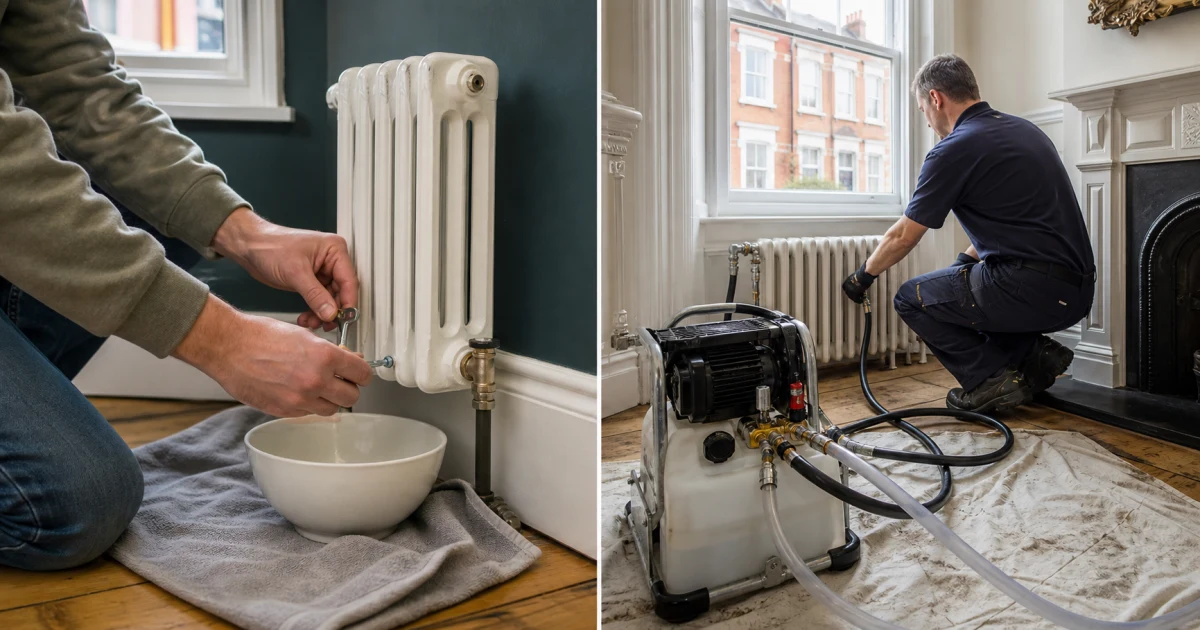
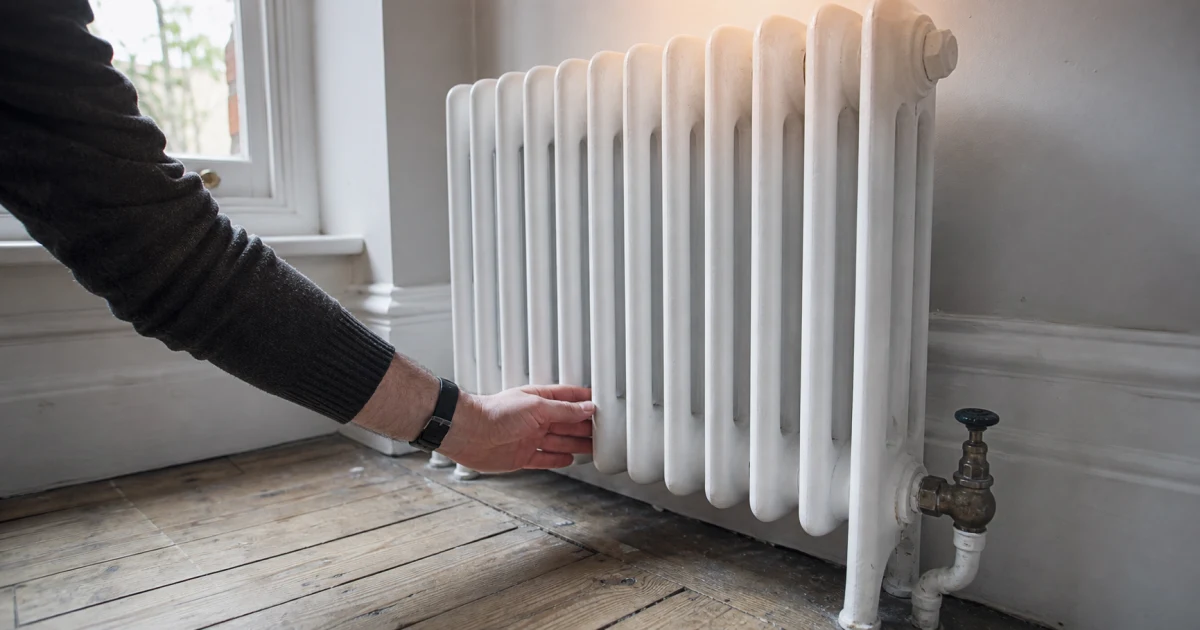
Cold radiators in a London home are often caused by sludge restricting circulation inside the central heating system. The classic symptom is a radiator that is hot at the top but cold at the bottom. Air usually causes the opposite pattern: cold at the top and warm lower down. That distinction matters because bleeding a radiator may release trapped air, but it will not remove heavy black sludge from the lower channels of the radiator.
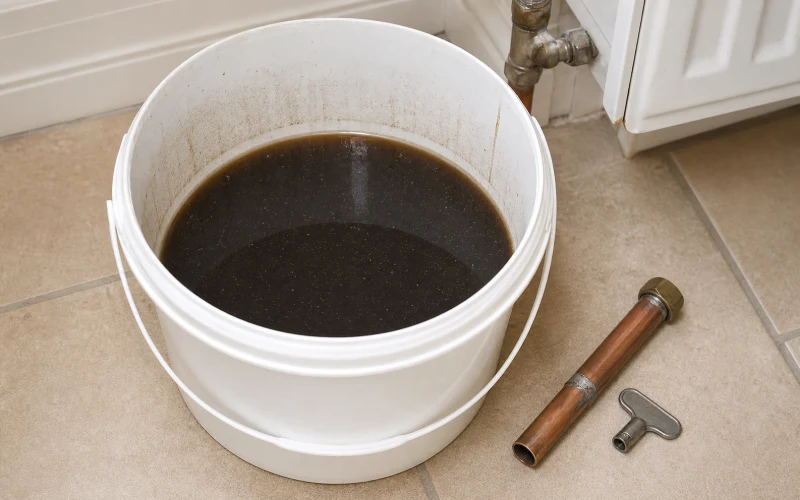
Heating sludge is mostly magnetite, a black iron oxide created as steel radiators and pipework corrode internally. It settles in low points, blocks narrow waterways, and reduces flow through radiators. In a clean system, hot water moves freely from boiler to pump to radiators and back again. In a sludged system, the boiler may be working hard while some rooms stay cold. A professional radiator power flush removes the sludge and restores flow where the system is suitable for flushing.
Why sludge builds up in London heating systems
London homes are especially prone to central heating sludge for three reasons. First, many properties have older radiators and pipework. Victorian terraces, Edwardian houses, post-war flats, and converted buildings often contain heating systems that have been altered several times over decades. Each alteration can introduce fresh oxygen and corrosion risk.
Second, London has hard water. Hard water does not directly create magnetite, but it encourages limescale around heat exchangers and valves. That makes the system less forgiving and increases the chance that small particles settle at restrictions.
Third, many systems are under-maintained. Inhibitor should be checked and topped up after draining work, radiator replacements, and boiler changes. If inhibitor is missing or weak, corrosion accelerates and sludge forms faster.
The main symptoms of central heating sludge
- Radiators cold at the bottom but hot at the top
- Some radiators take much longer to heat than others
- Dirty black or brown water when bleeding a radiator
- Boiler or pump noise, especially rumbling or gurgling
- Frequent boiler lockouts or circulation faults
- Thermostatic radiator valves sticking or responding slowly
- Rooms that never reach temperature despite the boiler running
- Rising energy bills without a clear lifestyle change
One symptom alone is not proof. A single cold radiator could be a stuck valve. Several cold-bottom radiators, dirty bleed water, and noisy circulation together make sludge much more likely.
Cold at the top or cold at the bottom?
A radiator cold at the top usually contains trapped air. Bleeding the radiator can help because air rises and stops hot water filling the top of the panel. If the radiator heats properly afterwards and stays that way, no central heating flush may be needed.
A radiator cold at the bottom usually contains sludge. The heavier sludge settles in the lower channels, so hot water passes through the upper part while the bottom remains cool. Bleeding may release a little air but the lower section stays cold because the sludge is still there.
A radiator cold from top to bottom can mean a stuck valve, a closed lockshield, poor balancing, a blocked feed, or no flow reaching that radiator. Diagnosis matters because a power flush solves circulation contamination, not every possible heating fault.
Why ignoring sludge costs more later
Sludge makes a heating system less efficient because heat is not distributed evenly. Homeowners often compensate by turning the boiler temperature or room thermostat higher. That can make the boiler run longer while the cold room still lags behind.
The bigger risk is component damage. Sludge can collect in pumps, diverter valves, plate heat exchangers, and boiler waterways. Modern boilers have narrower internal passages than older systems, so dirty water can trigger faults quickly. Boiler manufacturers may also ask for evidence that the system water was cleaned and inhibited before honouring some warranty claims.
Ignoring sludge also makes future work more expensive. If a boiler is replaced without cleaning the system, the new boiler inherits dirty water from old radiators and pipework. That is why many installers recommend a clean or power flush before or during boiler replacement.
Can you treat sludge without a power flush?
Sometimes. If symptoms are light, a magnetic filter clean, inhibitor top-up, or chemical clean may be enough. A homeowner can also bleed radiators, check obvious valve positions, and make sure the system pressure is correct. Those steps solve air and basic circulation issues, but they do not remove deep sludge from multiple radiators.
When several radiators have cold bottoms or the bleed water is black, a machine flush is usually more effective. The equipment circulates water and chemicals at high velocity, isolating each radiator in turn so debris is lifted and discharged. The system is then dosed with inhibitor to slow future corrosion.
What happens during a professional central heating flush?
The engineer first checks the boiler, radiator count, valves, system pressure, and symptoms. They take a water sample where possible. The flushing machine is connected to the system, cleaning chemical is added, and each radiator is worked through individually. The engineer keeps flushing until the discharge water improves, then adds inhibitor, checks heat-up, and balances the system as needed.
The process usually takes 4-8 hours in a London home. A flat may be quicker; a larger terrace or townhouse can take longer. If a radiator valve fails, a drain point leaks, or a pipe is too fragile, the engineer should stop and explain the options rather than pushing ahead blindly.
London examples
In a Camden conversion flat, two radiators cold at the bottom often follow years of partial draining during decorating and radiator moves. In a Hackney terrace, ground-floor radiators may be worst because sludge settles at the lower parts of the system. In a Southwark maisonette, a new boiler fitted onto old pipework can expose sludge that had been tolerated by the older boiler.
These examples are common because London's housing stock is old, altered, and dense. None of them means the whole system has failed. They mean the water quality and circulation need proper assessment.
When to book help
Book an inspection if several radiators are cold at the bottom, if dirty water comes out when bleeding, or if a boiler engineer has warned that sludge is present. For price planning, see our radiator power flush cost guide. For the work itself, use our radiator power flush London service or request a quote online via our contact form. We cover all 32 London boroughs with fixed pricing and no separate call-out fee.