A blocked drain affects one fixture or one branch pipe. A blocked sewer affects everything downstream of it — your entire property and often your neighbours' as well. The difference matters because a blocked sewer in London almost always becomes an active flooding emergency within hours, not days, and the financial and health consequences of waiting are severe. This guide explains the seven signs that distinguish a sewer blockage from a normal drain issue, what each one means, and the action steps to take tonight if you spot them. If two or more of these signs are present at the same time, do not wait for morning — request a quote online via our contact form immediately and stop all water use in the property.
1. Every Drain in the Property Is Affected at Once
The defining symptom of a sewer blockage is universal impact. If the kitchen sink, bathroom basin, shower, washing machine, and toilets are all draining slowly — or not at all — within the same evening, the problem is not in any individual branch pipe. It is in the lateral drain or the public sewer that everything ultimately connects to.
In a typical London terraced house, all internal waste merges into a single 100mm lateral that exits the property at the rear and runs beneath the garden to the public sewer in the street. As a result, one obstruction in that single pipe takes everything offline at once. The same is true for converted Victorian houses split into flats: a sewer blockage on the shared lateral affects every flat in the building simultaneously, regardless of which floor.
This sign alone is enough to justify an emergency call. Stop using water immediately — every flush, every shower, every washing machine cycle adds to the volume of waste with nowhere to go. Our emergency drain service operates 24 hours a day across all 32 boroughs, and we prioritise urgent jobs for the fastest possible response.
2. Sewage Backing Up Into Bathtubs, Showers, or Ground-Floor Sinks
If you turn on the kitchen tap and brown water rises in the shower tray, or if flushing the upstairs toilet pushes foul water up through the ground-floor basin, the sewer is blocked and waste is taking the path of least resistance. The lowest fixtures in the property become the only available exit for water that cannot continue forward into the sewer.
This is particularly serious in London basement flats and lower-ground-floor conversions, common throughout Camden, Westminster, Kensington, and parts of Lambeth. If the property's lowest fixture sits below the level of the public sewer, the blockage may originate in the street rather than in your private pipework — and the volume of sewage the system is holding back can be substantial. Furthermore, basement properties without a non-return valve are particularly vulnerable to street-level sewer surges during heavy rain.
Stop all water use in the property and any flat above you on the same stack. Do not attempt to plunge or flush the toilet to "force it through" — you will simply add to the volume of sewage that escapes into the lowest fixture. Call for emergency attendance and, if the property is on a shared system, alert your neighbours so they stop using water as well.
3. Multiple Toilets Will Not Flush
A single blocked toilet is usually a local problem — wet wipes, an oversized flush of paper, or a child's toy stuck in the trap. But when two or more toilets in the same property refuse to flush at the same time, the obstruction is downstream of both, in the soil pipe or the lateral drain. This is functionally the same as sign one, but it announces itself faster because toilets are the most-used appliance in most households.
Wet wipes remain the dominant cause of London sewer blockages, even those labelled "flushable." They do not disintegrate the way toilet paper does — they accumulate at bends, restrictions, and pipe joints, and combine with cooking fat from kitchen drains to form the same congealed material that produces street-level fatbergs. Thames Water has consistently identified wipes and fat as the leading cause of sewer blockages across the capital, with the 2017 Whitechapel fatberg the most dramatic illustration of the problem.
Do not continue flushing in the hope that the obstruction will clear itself. Each flush adds 6-9 litres of water to a system that is already at capacity. Our blocked toilet service prioritises multi-toilet failures, and the emergency guide walks through the immediate steps to limit damage while you wait.
4. Sewage Visible in the Garden, on the Driveway, or at an Inspection Chamber
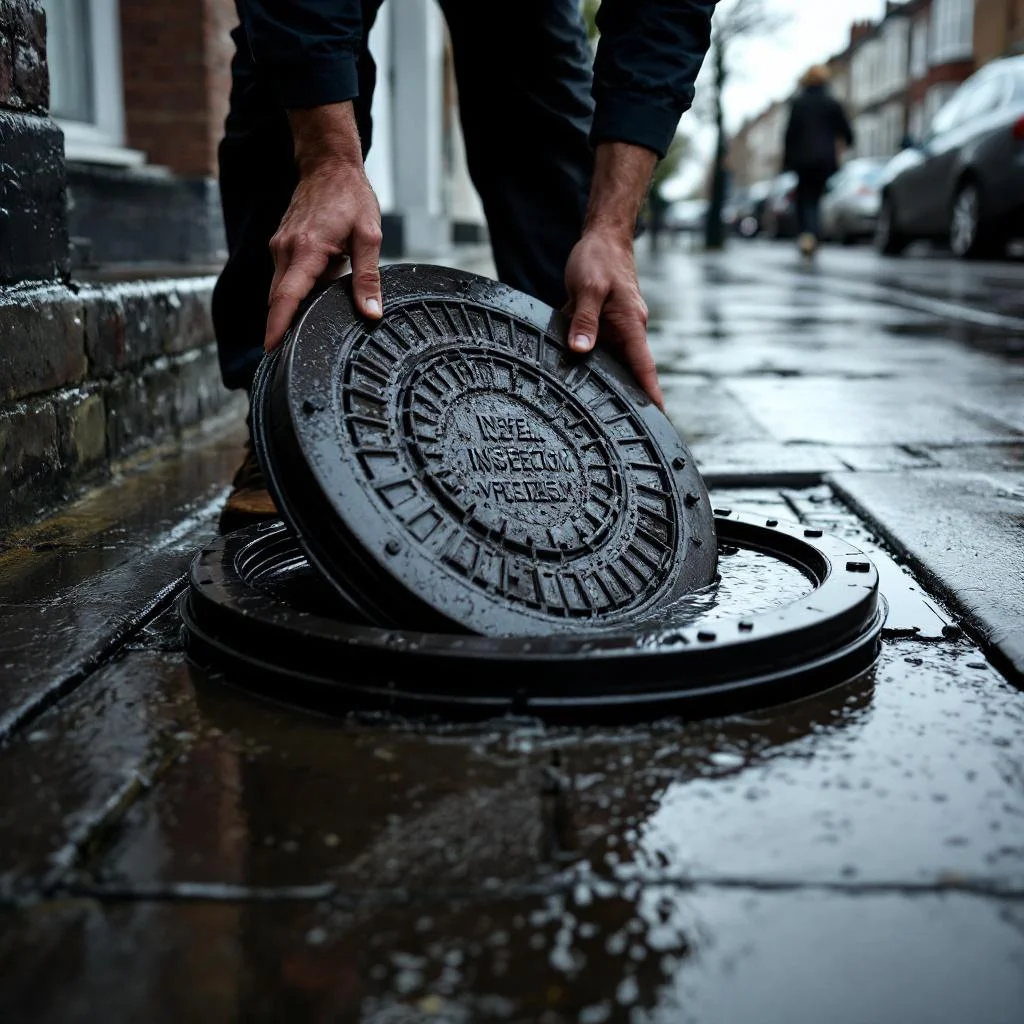
Lift the inspection chamber cover in your garden or driveway. Inside, you should see a clean half-channel with waste flowing freely from one side to the other. If instead you see standing sewage above the level of the channel, foul water rising up the chamber, or — worst case — sewage spilling onto the garden surface, the sewer downstream of that chamber is blocked.
This is the unambiguous signature of an active sewer emergency. The further the contamination has spread above the channel, the more pressure the system is under and the more imminent an internal backup becomes. In London terraces, particularly in Hackney, Islington, and Greenwich, a single shared lateral often serves three or four houses, and the inspection chamber sits at the property boundary or in the back garden.
Take three immediate steps. First, stop all water use in your property. Second, photograph the chamber for insurance and Thames Water records. Third, call for emergency attendance and, if the chamber is clearly on shared pipework, also report the blockage to Thames Water on 0800 316 9800. Our guide to Thames Water responsibility explains who pays for which section.
5. Strong, Persistent Sewage Smells Indoors or Outside
A faint kitchen smell that disappears after running the tap is usually a dried-out trap. A persistent, strong sewage smell that lingers in multiple rooms — or rises from the garden whenever you walk past a particular spot — is a very different signal. It means foul air is escaping the system somewhere it should not, and the most common cause is a blocked or partially blocked sewer that is venting backwards through the lowest available exit.
In London, the geology compounds the problem. Greater London sits on London Clay, which expands when wet and shrinks when dry, and the resulting seasonal movement cracks joints in older clay laterals. Once a joint opens up, foul air escapes into the surrounding soil and rises into gardens, basements, and ground-floor rooms. Furthermore, properties served by drainage installed before 1900 — common across the inner boroughs — frequently have multiple aged joints any of which can fail under sewer back-pressure.
A persistent sewage smell warrants same-day investigation. It is rarely the only sign of a sewer issue, but it is often the first one a household notices, particularly during warm weather when foul air rises faster. Combined with any of signs 1-4, it elevates the situation to an immediate emergency.
6. Gurgling From Multiple Drains Simultaneously
Air movement is the early-warning system for sewer blockages. When the sewer downstream is partially restricted, air pressure builds up and is forced backwards through the trap of every fixture in the property. The audible result is gurgling and bubbling — sometimes from one toilet when the bath empties (a common single-drain sign), but more seriously from multiple fixtures at once when nothing else is even running.
If you can stand in the kitchen and hear the bathroom toilet gurgling, or the washing machine outlet bubbles whenever the upstairs basin drains, the sewer is restricted but not yet fully blocked. This is a 24-48 hour warning before the partial blockage becomes complete and the symptoms in signs 1-5 appear. Acting at this stage is significantly cheaper and less disruptive than waiting.
A planned high-pressure drain jetting visit at the gurgling stage typically clears the developing obstruction in under an hour, often without any need for a CCTV inspection. By contrast, the same jetting service called out as an emergency once the property has flooded involves hygiene cleaning and significantly more disruption. Same-day attendance is standard at this stage — request a quote online via our contact form before the situation escalates.
7. Slow Drainage After Heavy Rain
London's combined sewer system carries both foul waste and surface water in the same pipes — a 1860s design choice by Sir Joseph Bazalgette that was correct for Victorian London but is now under significant strain. As a result, a sewer that operates marginally during normal use can be overwhelmed during heavy rainfall, and the symptoms appear suddenly. If your drains were fine yesterday but every fixture is slow today after a night of rain, the sewer downstream is at or above capacity.
This is particularly common in low-lying areas of London — parts of Southwark, Lambeth, and Wandsworth near the Thames, and basement properties throughout the central boroughs. Storm-induced backflow is also a known issue in Bromley and Greenwich, where the system carries surface water from large catchment areas into older pipework. Furthermore, mature trees lining London streets contribute leaf debris during autumn, which combines with peak rainfall to cause seasonal blockages.
A storm-induced backup may resolve on its own once the rain stops and the system catches up. However, if symptoms persist for more than a few hours after the rain ends, the blockage is not purely capacity-related and there is a structural obstruction in the line. Book a CCTV survey to identify it before the next heavy rain, when the same problem will recur and may flood the property.
What To Do Tonight If You Suspect a Blocked Sewer in London
If two or more of the signs above are present, treat the situation as an active emergency and follow these steps in order. First, stop all water use in the property. Turn off washing machines and dishwashers mid-cycle if necessary, ask everyone in the household not to flush, and do not run taps or showers. Every additional litre of water has to go somewhere, and right now there is nowhere for it to go but back into the property.
Second, lift any accessible inspection chamber covers in the garden or driveway. Look at the flow level in the half-channel and photograph what you see. This evidence is valuable for insurance claims and for Thames Water if the blockage turns out to be on adopted pipework. If the chamber nearest the house is full but the next one downstream is empty, the blockage is between them — useful information to give the engineer over the phone.
Third, contain any internal contamination. If sewage has already backed into a bath, shower, or sink, do not attempt to clean it with normal household products. The contamination is biohazardous and requires proper emergency drain service attention, often including post-clearance hygiene treatment. Keep children and pets out of the affected rooms.
Fourth, get help. Request a quote through our contact form — we're available 24 hours a day across all 32 London boroughs and prioritise urgent jobs for the fastest possible response. Our guide on what to expect from an emergency callout walks through what happens once the engineer arrives. If there is any indication the blockage may be on shared pipework — multiple properties affected, sewage at a chamber on the property boundary — also report to Thames Water on 0800 316 9800. You can pursue both lines in parallel; the faster response usually comes from the private contractor.
Frequently Asked Questions
What is the difference between a blocked drain and a blocked sewer?
A blocked drain affects a single fixture or branch pipe — one slow sink, one toilet that will not flush. A blocked sewer affects the lateral or public pipe downstream of the building, which means every fixture is impacted at once. Sewer blockages are significantly more urgent because the volume of waste involved is much larger and internal flooding is imminent.
Can I clear a blocked sewer myself?
No. Sewer blockages sit metres beyond the reach of any household tool, and attempting chemical cleaners or aggressive plunging can damage older clay or cast-iron pipework. Furthermore, the contamination involved is biohazardous and DIY attempts often spread waste through the property. Same-day professional attendance using high-pressure jetting is the only reliable approach.
Will my home insurance cover sewer backup damage?
Many London home insurance policies include drain or underground services cover, but the terms vary widely. Most insurers require photographic evidence of the contamination and a CCTV report identifying the cause and location of the blockage. Our standard emergency callout includes both, and we provide insurance-grade documentation as a matter of course.
How long does it take to clear a blocked sewer in London?
Most sewer blockages are cleared within 60-90 minutes of arrival using high-pressure jetting. Our average total time from first contact to flowing drain is 2-3 hours. Where the blockage involves structural damage requiring drain repair or relining, a temporary clearance restores flow on the day and permanent repair is scheduled separately.
Should I call Thames Water or a private contractor first?
If the blockage is clearly on shared pipework — multiple properties affected, sewage at a boundary chamber — both. Thames Water can be slow to attend non-life-threatening calls, often taking 24-72 hours, while a private contractor typically arrives within 60-90 minutes. Most London homeowners hire a private contractor for the immediate fix and pursue Thames Water afterwards if the fault was on adopted pipework.