
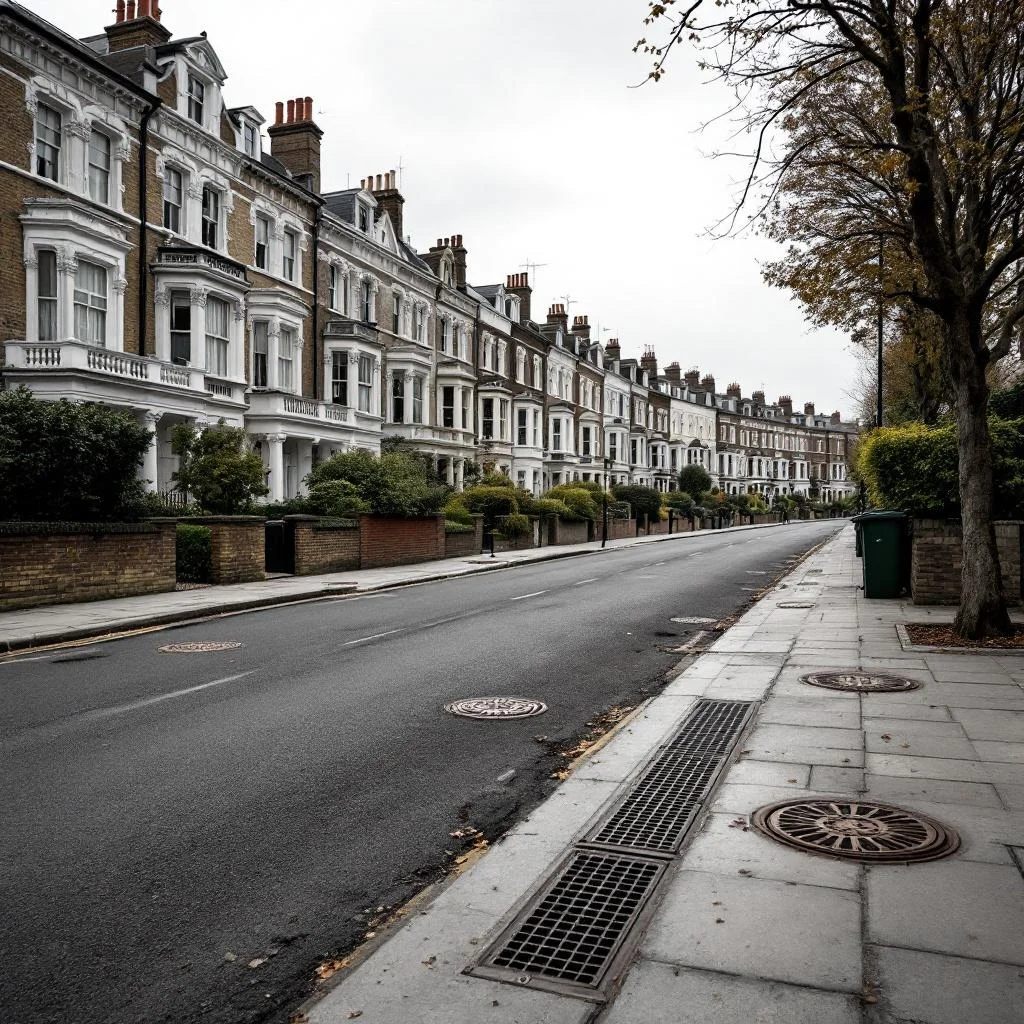
Some London boroughs face tougher drain problems than others, and the reasons are structural, not behavioural. Five boroughs stand out: Hackney, Islington, Lambeth, Camden and Tower Hamlets. Their residents do not have worse habits than anyone else, because the causes lie underground.
What they share is a mix of dense Victorian housing, old combined sewers, lost rivers, London Clay movement and mature street trees. As a result, the pipes under these boroughs work harder and have less margin for error. This article explains why each one is a drainage hotspot, and what owners and tenants can do.
1. Hackney: Victorian Density Meets London Clay
Hackney grew fast in the late nineteenth century. Long terraces of small homes sit side by side in places like Dalston, Stoke Newington, Hackney Central and Clapton. Their drains were usually laid as one 100mm clay run behind the gardens.
That run picks up many homes before it joins the public sewer at the front of the street. The shape is long, shallow, shared and narrow, which is the worst starting point when something goes wrong.
Hackney also sits on London Clay. As we explain in how London Clay soil damages drains, this clay swells when wet and shrinks when dry. It pulls joints apart at typical pipe depths.
A pipe that was sound decades ago may now be cracked at several joints. In addition, the borough has been replanted with mature street trees, such as plane, lime and sycamore. Their roots exploit every clay joint within reach.
The mix is unforgiving. For example, a blocked rear drain in Stoke Newington is often root-filled and displaced at the joints. Clearing it needs high-pressure jetting and often a follow-up CCTV survey.
Owners do well to book a survey on a regular cycle, rather than wait for the first internal flood. For local help, see our Hackney drain page. Our high-pressure drain jetting London guide explains what jetting does to a Victorian clay run.
2. Islington: Tree-Lined Squares and Tight Terraces
Islington's challenge starts with its conservation areas. Canonbury, Barnsbury, Highbury Fields and the streets round Upper Street are well-preserved Victorian terraces. Many have never had their original clay drains replaced. That is part of their charm, yet it also makes them prone to recurring blockages.
The borough is famously tree-lined. Mature planes and limes grow on nearly every street. They give shade, but their fine roots travel far underground in search of water.
To a tree, a clay drain with a hairline crack is an irrigation channel. Root intrusion therefore causes a large share of blockage call-outs here.
Density adds to the problem. Terraces in Tufnell Park or off Liverpool Road often share a rear drain that passes through many gardens. Since October 2011, those shared runs have been Thames Water's responsibility, although many owners do not know it. Our Thames Water vs homeowner responsibility article covers this.
Restored homes often send kitchen waste down old cast-iron stacks. However, these corrode inside and narrow over time. For local help, see our Islington drain page. If you are buying here, a pre-purchase CCTV drain survey is one of the best checks you can run.
3. Lambeth: The Lost Rivers Problem
Lambeth has a hydrology you cannot see from the street. Two of London's lost rivers cross the borough, the Effra and the Falcon. Victorian builders culverted both into the combined sewer network.
The Effra rises in Norwood and runs north-east through Brixton, Herne Hill and Kennington. It reaches the Thames near Vauxhall. Most residents have no idea that their basement sits above what is essentially a buried river dressed up as a sewer.
This has consequences. In heavy rain, the culvert and local combined sewers can surcharge. Water pushes back up through gully traps and into low-lying basements.
The same system carries sewage and stormwater together, so one blockage downstream can cause foul backups in many homes at once. Low-lying streets in Brixton, Herne Hill and Stockwell are at most risk.
Lambeth also has plenty of Victorian and Edwardian homes with shared 100mm rear drains. London Clay lies underfoot, and mature street trees add root pressure. The borough's drains therefore face every common pressure at once, plus the lost-river factor.
As we discuss in why London drains block so often, the network was never designed for modern rainfall or modern water use. Owners who worry about backflow in storms should consider non-return valves and gully covers. For help in the area, see our Lambeth drain page.
4. Camden: Combined Sewers and Bazalgette's Border
Camden sits at the heart of Sir Joseph Bazalgette's 1860s sewer network. His interceptor sewers carry London's waste east to the Beckton outfall. They pass beneath or near Camden Town, Kentish Town and the southern parts of Hampstead and Belsize Park.
The home drains that feed them are, in many streets, original Victorian clay. Because the system is combined, stormwater and sewage share the same pipes.
That design is why Camden sees the same problems again and again. In intense rain, the system fills quickly, and surcharge shows up in gullies, manholes and basement floor drains. Many Camden homes are large and have basement kitchens or bathrooms.
They are especially vulnerable when the local sewer backs up. A blocked outdoor drain in a thunderstorm is rarely a local problem alone.
Tree roots and London Clay add their familiar pressures. The borough also has many converted houses, and several kitchens and bathrooms may feed drains sized for one household. As a result, Camden sees a steady flow of blocked toilets and kitchen drains all year, with spikes in heavy rain.
Fit gully covers, use sink strainers and never flush wipes. These are the basics in our blocked toilet emergency guide. For help across the borough, see our Camden drain page.
5. Tower Hamlets: Density, Clay and the Rat Problem
Tower Hamlets faces every inner-London pressure: dense Victorian streets, London Clay movement and ageing combined sewers. It also has rats. Dense restaurant trade, a large population and an old, fragmented sewer network let rats thrive in pipework.
Rats do not block drains themselves. However, their movement widens existing cracks, and dead rats in drains add to blockages.
The housing is unusual too. Bethnal Green, Whitechapel, Stepney and Limehouse have some of the oldest occupied terraces in inner London. Many were rebuilt after wartime damage, with new connections added to Victorian drains. The result is often mismatched pipe sizes, awkward bends and undocumented links that catch debris easily.
Restaurants along Brick Lane, Whitechapel Road and Bethnal Green Road add to the issue. The borough was also the site of the 130-tonne 2017 Whitechapel fatberg, which shows the scale fat and wipes can reach. Where commercial fryers send fat into the same combined system as nearby flats, residential drains downstream pay the price. Owners and tenants here gain most from disciplined kitchen habits.
Never pour fat down the sink, use strainers and act fast on slow drains. For help, see our Tower Hamlets drain page. For an emergency, request a quote online via our contact form.
Why These Five London Boroughs Face the Toughest Drain Problems
Look at all five and one picture emerges. Each sits on London Clay. Each is dominated by terraced Victorian or Edwardian homes with 100mm clay drains. Each is heavily planted with trees.
Each lies within Bazalgette's combined sewer network. None of these facts is unique to one borough. What is unique is how they stack up.
For owners, repeat blockages are rarely down to habits alone. A flushed wipe will block any drain, yet a sound drain serving one home tolerates the odd slip. A century-old shared clay run with displaced joints and roots does not.
Therefore, the right response to a second or third blockage is not to blame the household. Commission a CCTV drain survey and find the structural fault.
Since the October 2011 private sewer transfer, many of the worst-hit runs belong to Thames Water, not the homeowner. Owners in shared rear-garden terraces may be paying for repairs they should not fund. Reading the boundary correctly, and holding CCTV evidence, can save money on repairs. For more, see our Thames Water responsibility article and our pricing guide for drain unblocking.
Frequently Asked Questions
Are the other London boroughs trouble-free?
No. Every London borough has streets with Victorian drains and clay-pipe faults. The five here simply combine more pressures more densely.
Outer boroughs such as Bromley, Croydon and Enfield see different patterns. In contrast, they have fewer combined-sewer surcharges, but more root intrusion in long suburban gardens. Westminster and Kensington have the same Victorian stock as Camden.
Should I avoid buying a property in these boroughs?
No. The drainage challenges are well understood and manageable. What matters is going in informed.
Commission a pre-purchase CCTV drain survey and find out whether the rear drain is shared. Budget for root-cutting jetting if mature trees are close. A home with a surveyed drain is a better risk than one whose drains were never inspected.
Does Thames Water acknowledge that some boroughs are worse than others?
Thames Water publishes pollution and overflow data by catchment. The interceptor sewers serving inner east and central London are among the most pressured parts of the network. That is one reason the Thames Tideway Tunnel was built. It takes overflow load off Bazalgette's original system.
How often should I have my drains surveyed in one of these boroughs?
For pre-1960 homes on a shared rear drain with mature trees nearby, a survey every few years is sensible. For converted flats with several kitchens and bathrooms feeding old stacks, check more often. New-build flats with modern plastic drains rarely need routine surveys, although pre-purchase checks are still useful.
Who do I call for an emergency in any of these boroughs?
Request a quote online via our contact form. We cover all five boroughs in this article, and others across London. For background on what to expect, see our emergency drain service guide.
Because every property is different, start with our guides to blocked drains and drainage mapping survey advice. We also cover blocked drains in Edgware and blocked drains in Enfield, so you can see how the work runs near you.