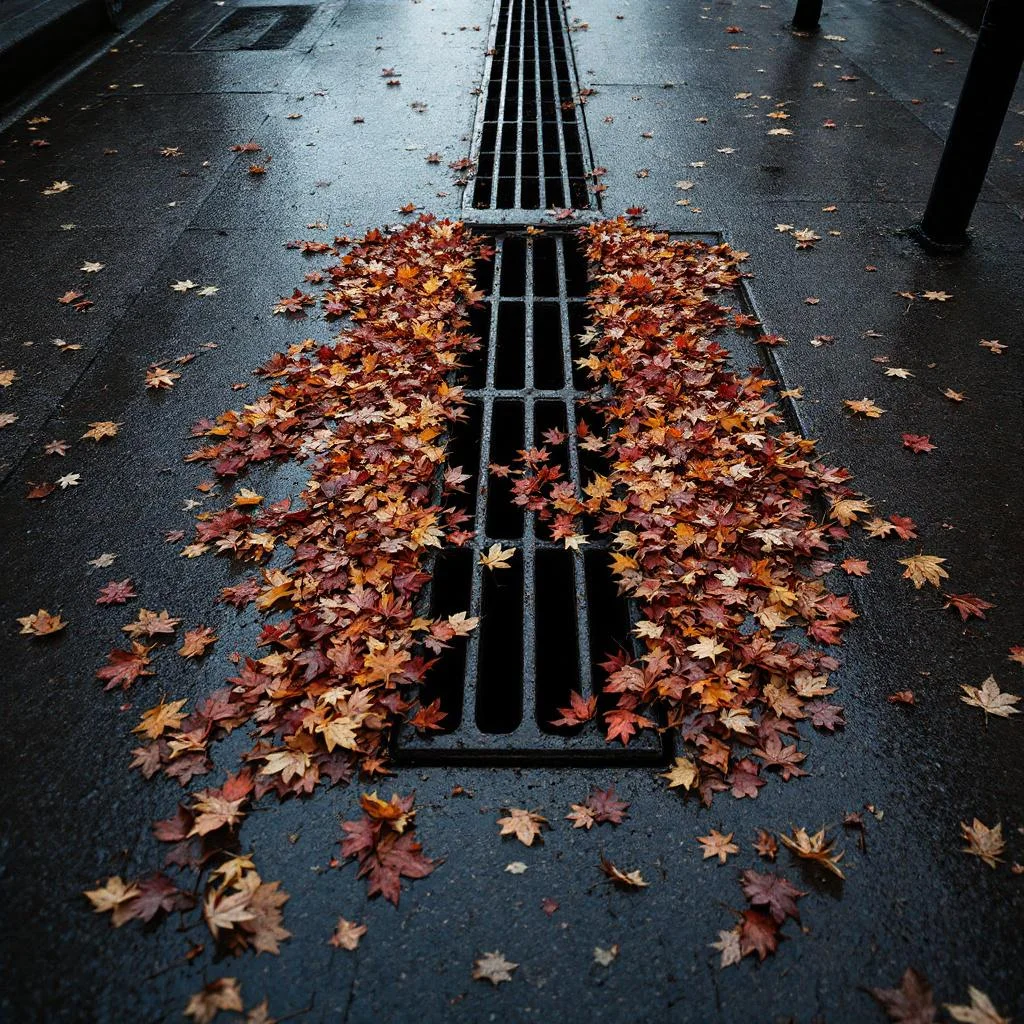
Every September, the same thing happens across London: the first autumn storms arrive before the leaves have fully fallen, and suddenly every drain that's been working fine for nine months is under pressure. Wet leaves form an almost impermeable mat over gully gratings, reducing inflow to near zero and causing surface water to back up — flooding pavements, front paths, and in the worst cases, ground-floor rooms. After 26 years clearing London drains in autumn, this is what I'd recommend checking at your property before October arrives.
Why Autumn Is London's Worst Month for Drainage
The combination of leaf-fall timing and early autumn storm intensity creates the worst conditions of the year for urban drainage. In late September and October, large-canopy trees — London plane, horse chestnut, and lime — drop leaves while still fully sized and wet. A single large plane tree can shed leaves covering several square metres of pavement.
When these leaves settle over a gully grate — even a relatively large one — they seal the inflow within minutes. Surface water then pools on the pavement, road, or garden until either the leaves are disturbed or enough water accumulates to lift the mat. In areas with low-gradient roads or sunken front paths, this can mean 50–100mm of standing water before any drainage occurs.
At the same time, leaves that do enter the drain system accumulate at bends, junctions, and in inspection chambers. Unlike grease or grit, decomposing leaves create a fibrous mat that's difficult to shift with water pressure alone and often requires physical removal.
London Borough Risk Assessment: Which Areas Are Worst Affected
The boroughs with the highest density of deciduous street trees — and therefore the highest autumn drainage risk — are broadly the inner and middle-ring boroughs with Victorian-era tree planting:
- Highest risk (very high tree density, frequent callouts Sep–Nov):
- Camden and Islington — Victorian and Edwardian streets with large London plane trees. Gully blockages from leaf-fall are a near-annual event in streets like those around Highbury, Holloway, and Kentish Town.
- Hackney and Haringey — Large mature planes and limes in Stoke Newington, Finsbury Park, and Crouch End. These areas generate high autumn callout volumes.
- Lambeth and Southwark — Herne Hill, Tulse Hill, and Dulwich have exceptional tree density. Some residential streets become effectively impassable in wet leaf conditions.
- Richmond and Kingston — The outer southwest boroughs have the highest overall tree density. The combination of large parkland trees and residential streets creates enormous leaf volumes.
- Moderate risk:
- Wandsworth, Merton, Lewisham — Good tree stock but slightly less density than the highest-risk areas. Drain blockages peak in October.
- Barnet, Enfield, Bromley — Large gardens and street trees in outer suburban areas. Garden drainage (soakaways, gullies, linear drains) is most at risk rather than street gullies.
- Ealing and Hounslow — Mature residential streets with plane and cherry trees. October and November are peak blockage months.
- Lower risk (but still worth checking):
- Inner-city areas with less tree cover — parts of Tower Hamlets, Westminster city centre, the City of London.

Your Property Autumn Drain Checklist
Work through this before mid-October:
External gullies. Check every gully in your rear garden, front path, and side passage. Lift the grate (or clear around it), remove any accumulated debris, and check that the inflow runs freely by pouring a bucket of water in. If the water drains slowly, rod or clear the trap.
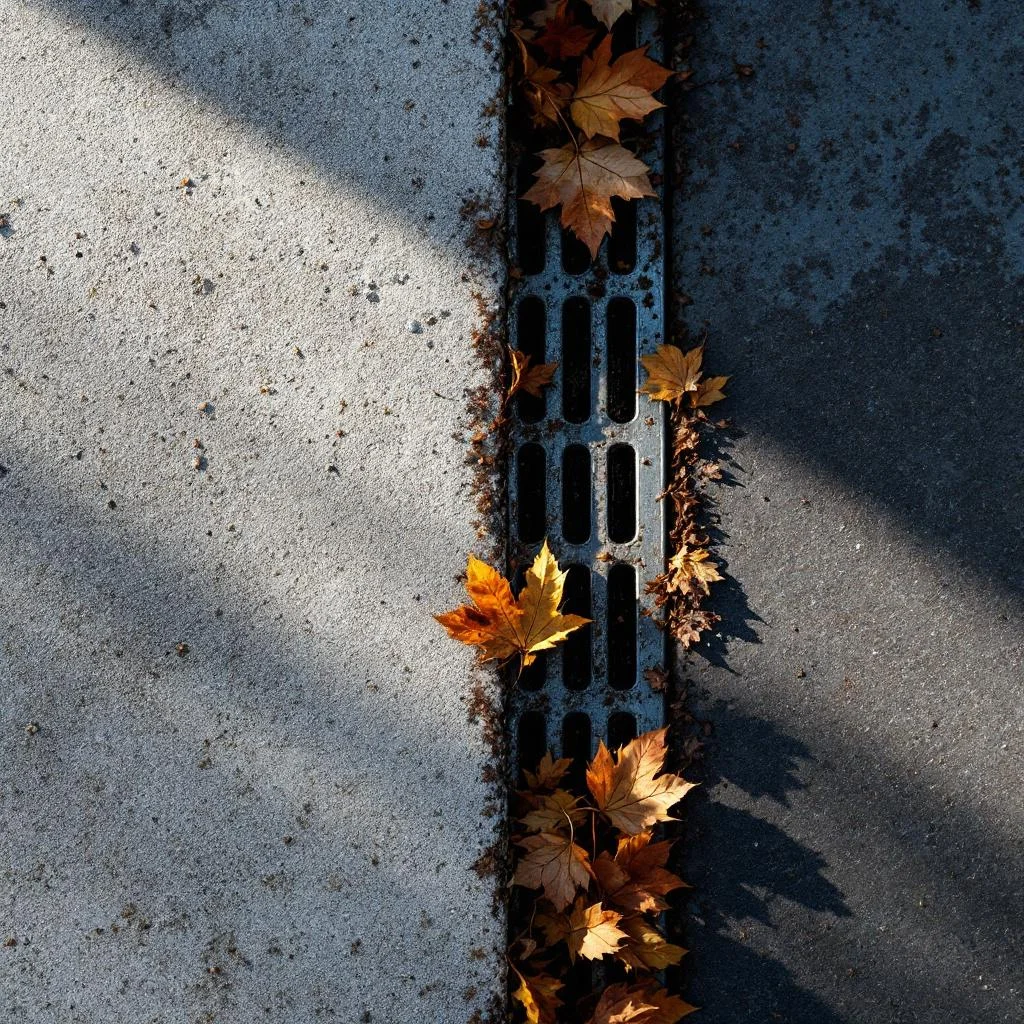
Linear drains. Many modern London properties have linear (channel) drains across the rear of the garden or along the side of an extension. These have continuous slots that block more easily than circular gullies. Clear debris from the channel body, not just the top.
Downpipe gullies. The gully at the base of a downpipe — where the rainwater pipe discharges to the drain — is a particular trap for leaf accumulation. In autumn, leaves entering the top of the downpipe travel all the way down and accumulate here. Check each downpipe gully in October.
Flat roof outlets. If you have a flat roof, the outlet and any pipe run from it will catch leaves that blow across the roof. A blocked flat roof outlet causes pooling that risks roof membrane damage. Check and clear in October.
Front path camber. If your front path slopes away from the house but the drain at the low point is slow or blocked, water will pool toward the door threshold. The path drain is often overlooked because it's normally adequate — but in leaf-fall conditions it can't keep up.
Inspection chamber. Open the inspection chamber (if accessible) and check whether there's any leaf debris or silt accumulation in the invert. A partial accumulation in the chamber slows the whole system.
What to Do If a Gully Is Already Blocked
For a blocked street gully (in the road or pavement), report it to your London borough council — this is highway drainage, not Thames Water's responsibility.
For a blocked gully on your private property — rear garden, front path, shared courtyard — this is your responsibility. Simple gully blockages can often be cleared by hand or with a small drain rod. More persistent blockages, or blocked gullies combined with a slow main drain, benefit from professional jetting.
Our drain jetting service covers gully clearing and main drain jetting across all London boroughs. For persistent autumn blockages, a CCTV drain survey after clearing will confirm whether there are structural issues accumulating debris beyond the gully itself.
Preventive Measures Worth Considering
Gully guards. Mesh guards placed over gully gratings catch large leaf debris before it enters the drain. They require weekly emptying in peak leaf-fall but prevent the complete blockage that occurs when leaves saturate and mat. Available from builders' merchants.
Annual pre-winter jetting. For properties with recurring autumn blockages, an annual jetting of the drainage runs before the leaf-fall season clears accumulated summer grease and grit, leaving maximum capacity for the autumn peak. Many of our regular customers book an October pre-winter jetting as a routine.
Tree management. If an overhanging tree is the source of repeated drain problems, the local authority (if it's a street tree) or arborist advice (if it's on your property) may offer solutions. Reducing canopy spread by appropriate pruning reduces leaf volume on your drainage.
What We See on the Ground in October and November
Across our autumn callouts, three patterns repeat year after year. First, the late-September warm spell that London now reliably sees in early autumn keeps leaves on the trees longer than expected — then a single overnight storm strips entire canopies, and we get a wave of blocked-gully callouts within 48 hours. Second, properties on the boundary between two boroughs often discover their gully is actually maintained by neither council until both have been called. Third, garden owners who installed a new patio or extension in the previous five years are over-represented in autumn callouts: the additional impermeable surface area exceeds what the original soakaway or surface drain was sized for, and autumn leaf-fall pushes a marginal system over the edge.
If you have already had blocked drains in two consecutive autumns, the Met Office seasonal outlook is worth bookmarking — it gives a useful early indicator of the wet-week risk in October and November. We pair that with our own internal callout data and pre-position vans across Camden, Islington, Hackney and the steeper South-East London streets covered in our Greenwich, Lewisham and Bromley hill-streets guide when the storm warnings land. For homes with recurring autumn problems, our drain unblocking service covers all 33 London boroughs.
Frequently Asked Questions
Who is responsible for clearing blocked street gullies in London?
Highway gullies — in the road or pavement — are the responsibility of your London borough council. Report blocked gullies via the council's website or by calling their street services team. Thames Water is not responsible for highway drainage.
Can I clear a garden gully myself?
Yes, for surface debris and gully pot accumulation. Use gloves, remove the grate, lift debris from the gully pot, and flush with water. If the gully drains slowly after clearing, there may be a blockage further down the drain requiring professional jetting.
How often should I check my drains in autumn?
A weekly check of external gullies and downpipe outlets from late September to November is good practice in high-leaf-fall areas. A monthly check is adequate for properties with less tree cover.
Is leaf blockage covered by home insurance?
Accidental damage caused by drain blockage is covered by some home insurance policies. However, a blockage caused by gradual accumulation of leaves — rather than a sudden event — may be treated as maintenance failure. Check your policy wording. Preventive maintenance is the more reliable protection.
Do you cover autumn drain maintenance across all London boroughs?
Yes. Request a quote online via our contact form to arrange pre-winter jetting or a drain survey. We cover all 33 London boroughs.