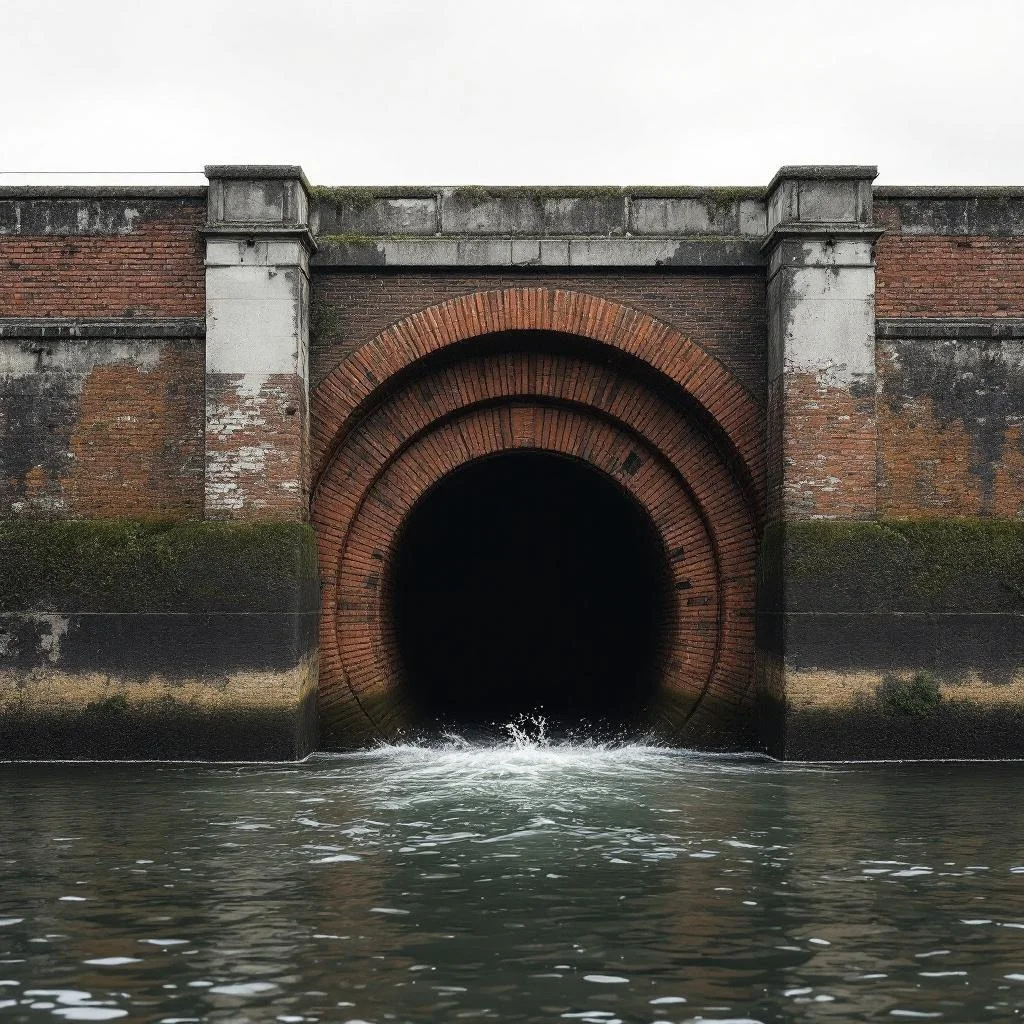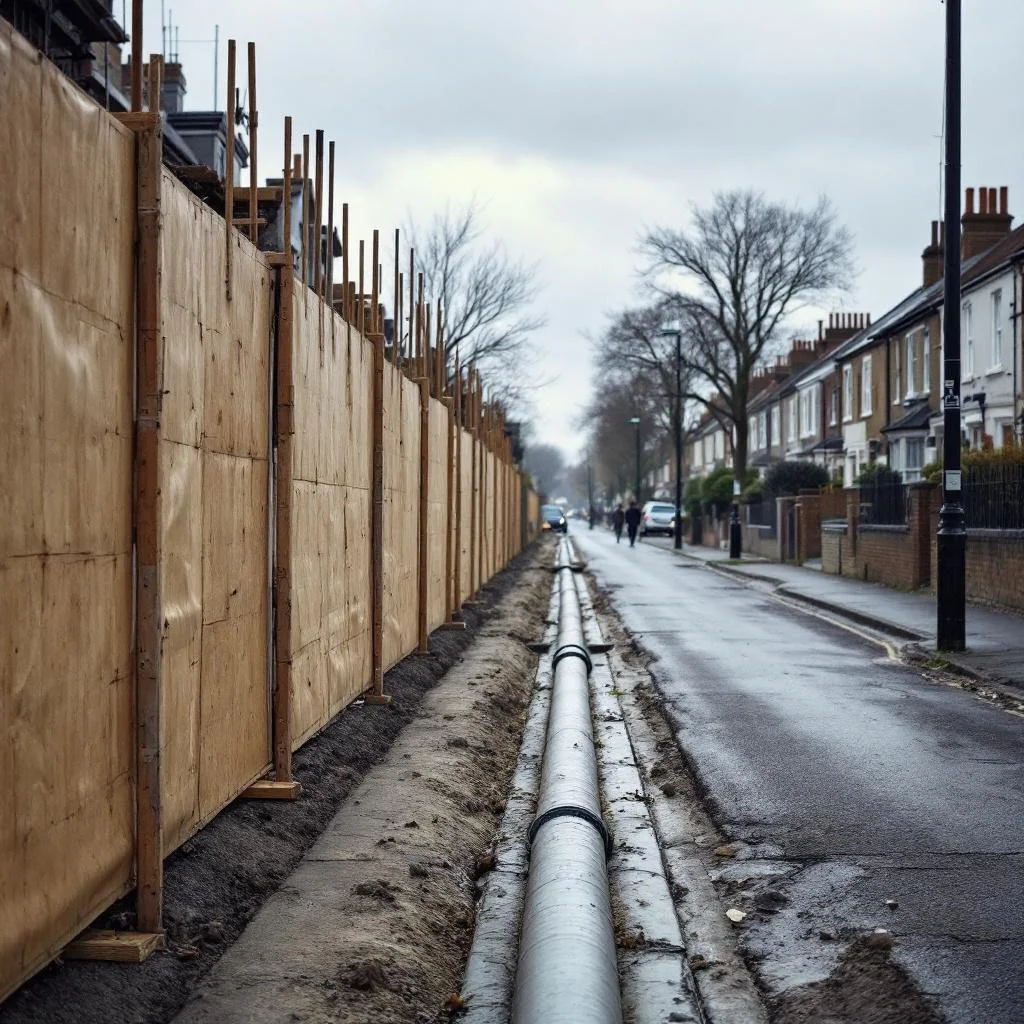
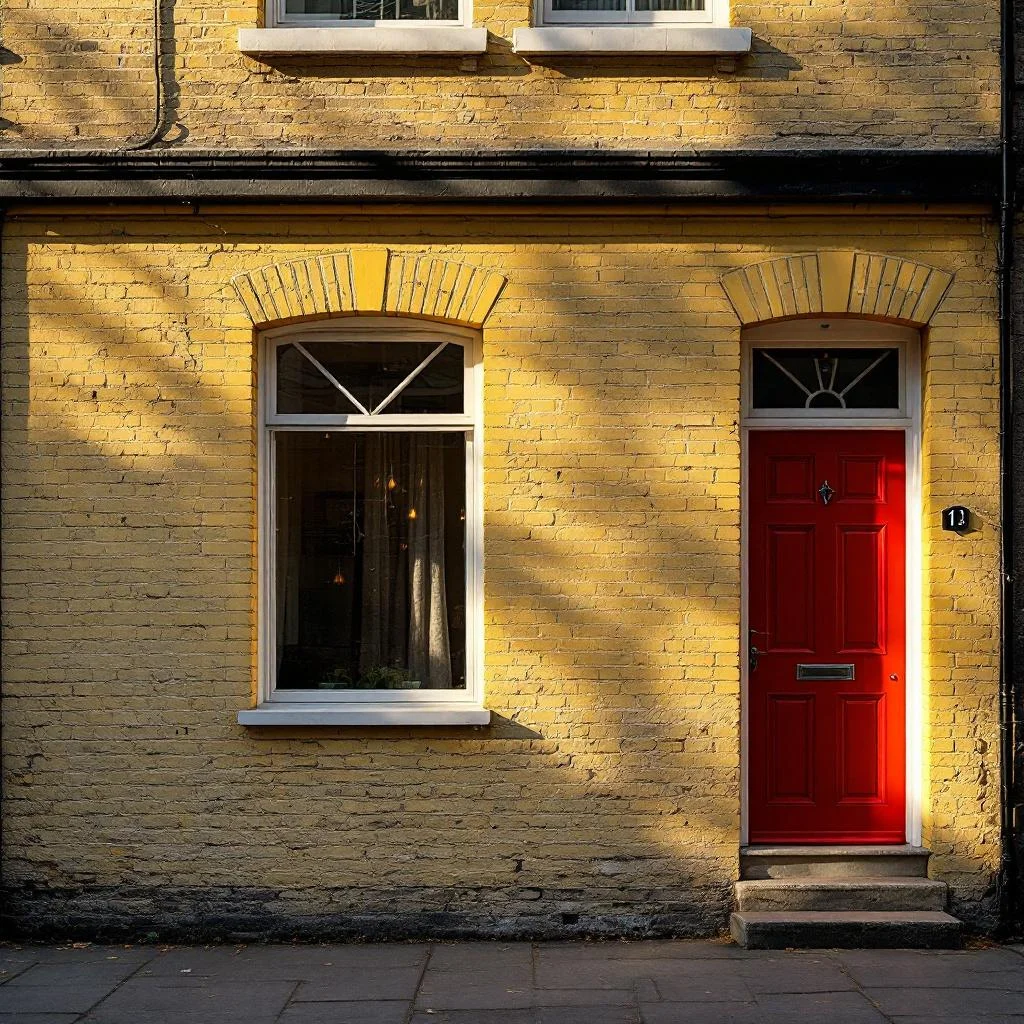
Camden, Islington, and Hackney share the same drainage problem. All three boroughs are built almost entirely on Victorian terraced housing stock — yellow stock brick, two-up two-down, extended at the rear, converted into flats — with drain runs that have not been fundamentally changed since the 1880s. When residents of these boroughs contact us about a blocked kitchen drain, the cause is almost always the same: a 140-year-old clay pipe that was designed for far less fat, food waste, and daily cooking than it is currently handling.
The Victorian Terrace Kitchen Drain: Why It Fails
The pipe dimensions
A Victorian kitchen drain in Camden, Islington, or Hackney is typically 75–100mm in diameter — the minimum required in the 1870s building codes. Modern guidance specifies 110mm as a minimum for kitchen drains serving a busy household. The consequence of undersizing is that the effective bore — already reduced by a century of grease and scale accumulation — is frequently less than 60mm in practice. A 60mm bore blocked by a fat deposit takes minutes to fail completely.
The gradient problem
Victorian kitchen drains often run at lower gradients than current standards require — partly because the pipes were laid by eye rather than by level, and partly because decades of London Clay movement have further reduced the fall. A drain with insufficient gradient allows grease and food particles to settle on the pipe wall rather than being flushed through by the flow. These settled particles attract further fat and debris until a partial blockage forms.
The shared run
In most Camden, Islington, and Hackney terraces, the kitchen drain does not run directly to the public sewer. It runs to the back of the property, under the rear garden, and joins a shared combined lateral — a larger clay pipe serving multiple properties — before reaching the sewer. This shared run means that a blockage in one kitchen can manifest as slow drainage in multiple households simultaneously. Identifying which kitchen is causing the blockage in a shared run is considerably harder than locating a blockage in a single-property pipe.
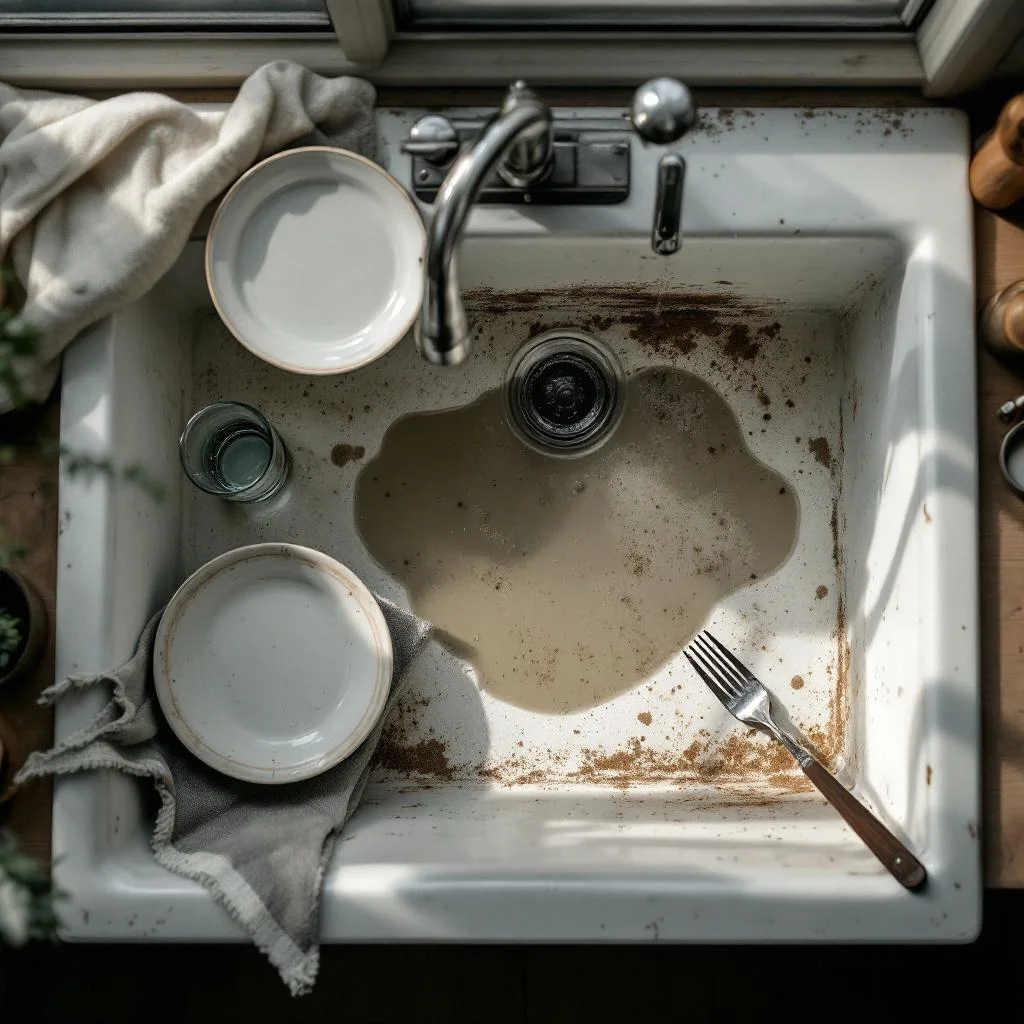
The Three Causes of Kitchen Drain Blockages in These Boroughs
Cooking fat accumulation
This is the primary cause of kitchen blockages across Camden, Islington, and Hackney, and it is worsening. London's population density means kitchens are used intensively. Furthermore, cooking fat — whether poured directly, carried by dishwater, or scraped off pans — cools as it moves through the pipe. It then solidifies on the pipe walls. In a Victorian 75mm clay pipe already narrowed by scale, a modest fat deposit is enough to cause a complete blockage.
The boroughs' restaurant density adds to the problem in shared drains: a single restaurant or takeaway connected to a residential shared lateral adds far more fat load than the pipe was designed to handle.
Food waste disposal habits
Food waste disposers (installed in some kitchen sinks) generate fine organic particles that travel further into the drain than lumps do, but settle in low-gradient sections and contribute to blockage formation over time. Without a disposer, food scraped into the sink drain carries sizable particles that settle within the first few metres of the pipe run.
Drain age and structural degradation
After 140 years, clay pipes develop internal surface degradation — micro-fractures, scale build-up, and erosion of the internal glaze that once made the surface smooth. A degraded pipe surface is significantly more prone to catching fat and debris than a new pipe with a smooth bore. In boroughs like Camden and Islington where tree coverage is high, root infiltration through joint fractures adds a further physical obstruction that fat and food debris accumulate around — an effect amplified by BGS-mapped London Clay shrink-swell beneath these inner-north terraces.
Signs Your Kitchen Drain Is Developing a Blockage
- Slow drainage that takes minutes rather than seconds to clear after washing up
- Gurgling from the kitchen drain during or after use
- A persistent smell of cooking fat from the drain, particularly during hot weather
- Water backing up into the sink during use of the dishwasher
- Slow drainage in the bathroom on the same floor as the kitchen (indicating a blockage in the shared run below junction level)
Any of these signs is worth acting on immediately. A partial kitchen blockage in a Victorian terrace becomes a full blockage within days to weeks, and once the drain is fully blocked, clearing it is more complex and expensive than if it is caught early.
How Kitchen Drain Blockages Are Cleared
Jetting
High-pressure drain jetting is the standard method for kitchen drain blockages in Victorian terrace properties. A flexible jetting hose with a rear-facing nozzle is fed through the pipe, breaking up fat deposits and flushing them downstream. A single jetting pass on a fully blocked 75mm kitchen drain typically takes 30–60 minutes. Multiple passes may be needed for a heavily accumulated drain.
For kitchen drain blockages in Camden, Islington, and Hackney properties we typically achieve a first-time clear rate of over 90% with high-pressure jetting alone.
CCTV survey
Where a kitchen drain blocks repeatedly — more than twice in 12 months — a CCTV survey is warranted before the next jetting. Recurring blockages almost always have a structural cause: a root intrusion, a displaced joint creating a ledge that catches debris, or a low-gradient section where solids settle. Jetting clears the symptom; CCTV identifies the cause. See our CCTV drain survey service for more detail.
Pipe relining
Where the CCTV survey reveals a fractured pipe or multiple open joints, relining is often the most cost-effective solution. A CIPP (cured-in-place pipe) liner installed inside the existing clay pipe seals the defects and creates a smooth new bore — reducing future blockage risk significantly. Relining a 10–15 metre kitchen drain run is substantially less costly than excavation.
Prevention in Victorian Terrace Properties
The most effective prevention steps for Camden, Islington, and Hackney households:
- Never pour cooking fat down the drain — collect it in a container and dispose of it with household waste once cooled
- Use a sink strainer to catch food particles before they enter the drain
- Flush the kitchen drain with boiling water weekly — run the tap at full flow for 2–3 minutes. This softens and flushes minor fat deposits before they accumulate
- Book a preventive jetting every 2–3 years for properties with Victorian 75mm kitchen drain runs, particularly where cooking volumes are high or a dishwasher is connected
Our blocked drain service covers Camden, Islington, and Hackney with fixed-price attendance and urgent jobs prioritised for the fastest possible response.
Frequently Asked Questions
Why does my kitchen drain block even though I don't pour fat down it?
Fat enters the drain not just from deliberate disposal but from washing up — every pan, plate, or cooking utensil carries residual fat. Dishwashers also release fat from crockery and cookware. In a Victorian terrace with a narrow-bore, low-gradient kitchen drain, even moderate fat loads accumulate over time.
My kitchen drains slowly but has not fully blocked. Should I wait?
No. A slow drain is a partially blocked drain. In a Victorian 75mm clay pipe, the gap between "slow" and "fully blocked" is days to weeks. Book a jetting now — it costs less than clearing a full blockage and eliminates the risk of an overflow.
Could a kitchen blockage affect my upstairs bathroom drain?
If the kitchen and bathroom drains join before the shared lateral — as they do in most Victorian terrace configurations — a partial blockage at or below the junction point will cause slow drainage in both. Gurgling from the bathroom drain when the kitchen sink empties is a reliable indicator that the blockage is below the junction in the shared section.
Is the shared drain between my terrace and the neighbours' Thames Water's responsibility?
Since October 2011, a drain shared between two or more properties is Thames Water's responsibility. See our full guide on drain responsibility in London for more detail. If the blockage is confirmed to be in the shared section, report it to Thames Water alongside your private clearance.
How quickly can you attend a kitchen drain blockage in Camden, Islington, or Hackney?
We cover all three boroughs and prioritise urgent jobs for the fastest possible response, 24 hours a day, 365 days a year. Request a quote online via our contact form for immediate attendance.