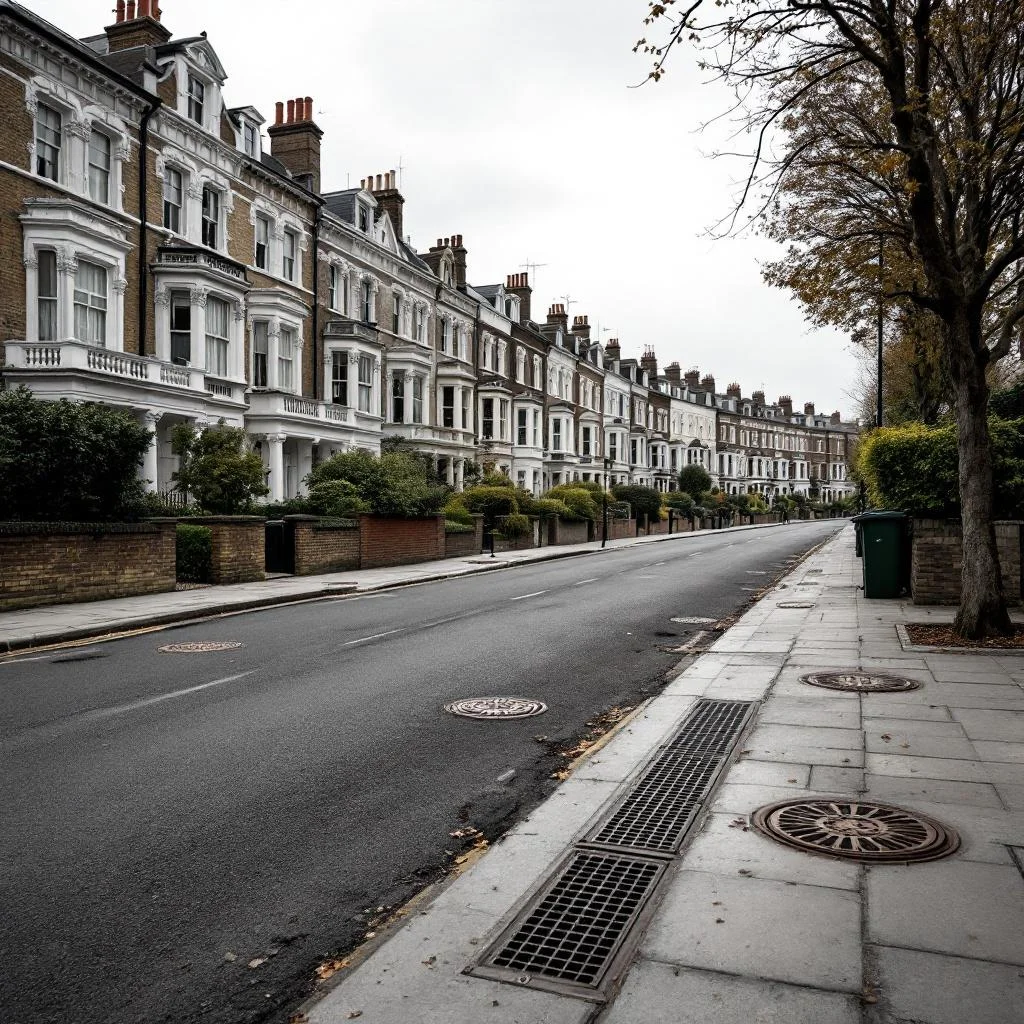
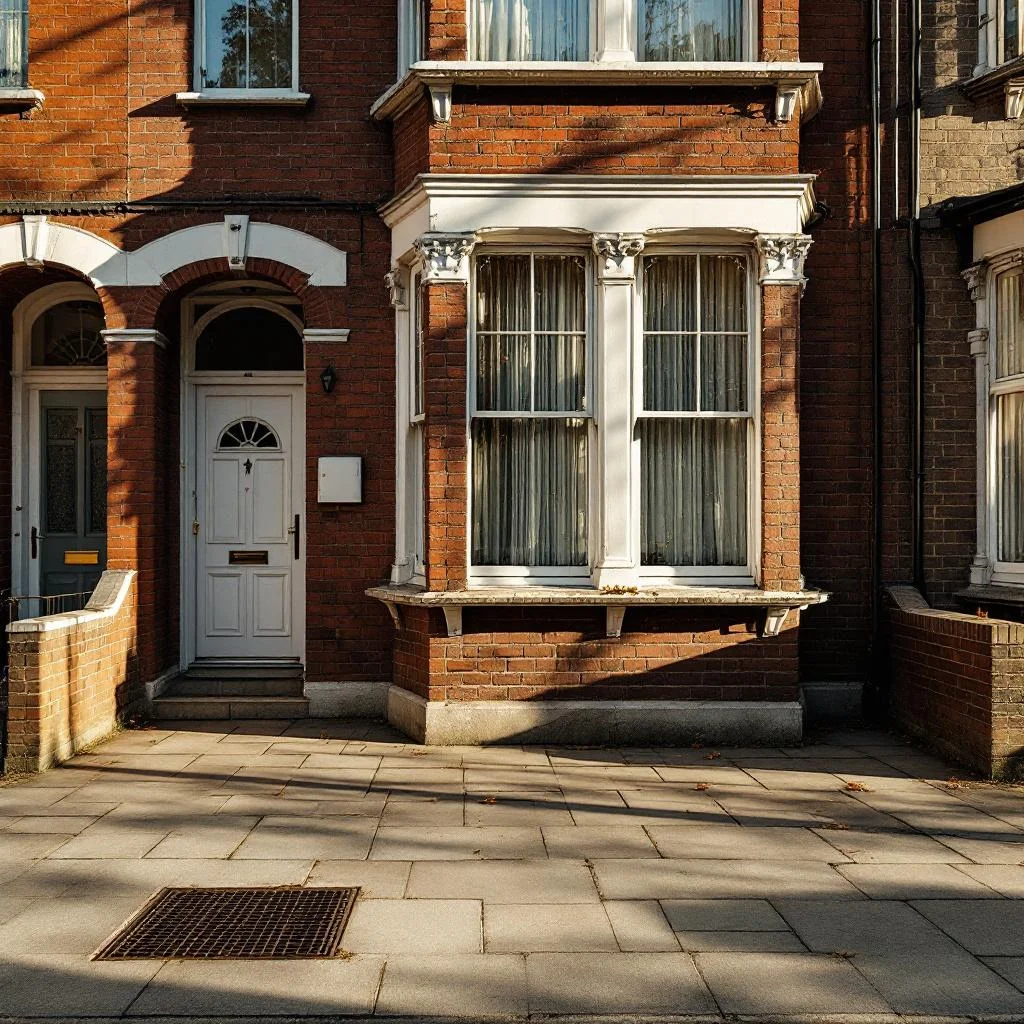
Victorian terraces make up the largest single category of housing stock in inner London — somewhere between 30 and 40 per cent in boroughs like Islington, Hackney, Camden, and Lambeth — and they share five specific drainage weaknesses that newer properties simply do not have. Shared lateral runs serving multiple houses, a 100mm pipe bore that was never designed for modern water usage, original encaustic tile floors laid directly over the drainage, undocumented Victorian rear extensions sitting on top of buried pipework, and rigid sand-and-mortar joints that have been failing slowly for 130 years. None of this is a defect of any one property. It is the inherited pattern of how late-19th-century builders worked, and understanding it is the first step to managing it. What follows is an honest look at each cause and what an owner can sensibly do about it without ripping up the back garden.
1. Shared Lateral Drains Serving the Whole Terrace
Most Victorian London terraces were built as a single drainage scheme, not as five or ten independent properties. A single lateral drain typically runs the full length of the rear of the row, beneath the garden walls or shared yards, with each house dropping into the same pipe. That lateral then discharges into the public sewer at one end of the terrace.
This means a blockage anywhere along the run affects every property upstream of it. If the seventh house in the terrace has a wet-wipe blockage forming at its connection, the first six houses will experience surcharging WCs and slow drainage long before anyone realises the cause is two doors down. Disputes between neighbours about whose problem it is are common — and frequently misdirected, because the actual blockage is rarely under the property of the person reporting the symptoms.
There is some good news. Since October 2011, Thames Water assumed responsibility for shared private sewers serving more than one property under the Water Industry (Schemes for Adoption of Private Sewers) Regulations 2011 — meaning that lateral run is, in most cases, no longer a homeowner cost to clear. Many owners are still unaware of the change and continue paying for repairs they should not be funding. We cover this in detail in our Thames Water vs homeowner responsibility guide. If you have a recurring shared-drain blockage, check the responsibility before you pay for the next clearance.
2. The Narrow 100mm Bore
The standard residential drain bore in Victorian London is 100mm — four inches in old money. That was perfectly adequate for the household of the 1880s: a single WC, a kitchen sink, perhaps a copper boiler in the scullery, and modest water consumption. The same 100mm pipe today serves households with two or three bathrooms, dishwashers, washing machines, power showers, and a daily water consumption that is often eight to ten times the original design load.
The bore itself has not changed. What has changed is what passes through it and how often. A modern household generates more wet wipes, more sanitary products, more cooking fat, more hair, and more general waste than the original pipe was ever sized for. The result is that any internal narrowing — fat deposits, root intrusion, a slightly displaced joint — has a disproportionate effect, because the pipe is already operating at the limit of its hydraulic capacity.
This is also why fatberg formation is so much faster in Victorian boroughs. A 30 per cent reduction in bore diameter from fat deposition reduces flow capacity by more than 60 per cent. Combined with the rough internal surface of glazed clay (modern smooth plastic is largely self-cleaning at normal flows), Victorian pipes accumulate deposits steadily and need either professional high-pressure jetting every few years or diligent enzymatic maintenance to stay clear.
3. Encaustic Tile Floors Laid Over the Original Drainage
Walk into the hallway of almost any Victorian London terrace and you will find the original encaustic tile floor — geometric Minton-style patterns laid in lime mortar over a screed bed, often with a basement or void below. Beneath that floor, in many properties, runs the original soil pipe from the upstairs WC down to the underground drain. In a typical mid-terrace house this drops through a void in the corner of the hallway or behind the under-stairs cupboard.
This creates a specific maintenance problem. If that internal soil pipe needs repair or replacement — because of a corroded cast-iron section, a failed joint, or persistent blockages — accessing it means lifting original encaustic tiles that are increasingly difficult to source replacements for. We have seen homeowners refuse essential drain repairs purely because the cost of recovering the original tile floor afterwards exceeded the repair itself. This is not paranoia: matching Minton patterns to original colour ways can run to several hundred pounds per square metre.
The practical answer is to use internal pipe relining wherever possible. CIPP relining inserts a flexible liner into the existing soil pipe and cures it in place, sealing cracks and joints from the inside without lifting any flooring. It is not always feasible — severe collapse or full deformation rules it out — but for the typical Victorian internal soil stack with corroded cast-iron sections and failing joints, it can save the original floor entirely.
4. Undocumented Victorian and Edwardian Extensions
Most Victorian terraces in London have been extended at least once, often twice, sometimes three times. The original closet wing at the rear was extended into a kitchen in the Edwardian period, then a side return infill in the 1990s, then a full rear extension in the 2010s. At each stage, somebody decided what to do about the drainage that was already in the ground. Sometimes it was rerouted properly. Sometimes the new floor slab was simply poured directly over the existing pipe.
The latter is more common than anyone is comfortable with. We routinely find Victorian clay drains running directly beneath modern kitchen extension slabs with no inspection access whatsoever. When those pipes fail — and clay pipes 130 years old do fail — accessing them requires breaking out kitchen flooring, which is a substantial cost and disruption above the actual drain repair.
If you are buying a Victorian London property with a rear extension, particularly one built before modern Building Regulations enforcement (broadly anything pre-2000), commission a pre-purchase CCTV drain survey before exchange. The survey will map the actual drain runs, identify whether anything has been built over without rerouting, and flag any failed sections that the seller is statutorily not required to disclose. The survey cost is trivial against the potential cost of remedial work if the underlying drainage has already failed.
5. Original Sand-and-Mortar Joints Failing After 130 Years
The original Victorian clay-pipe joints were sealed with a sand-and-cement mortar, sometimes with a hemp or jute gasket, packed by hand into the spigot-and-socket connection where one pipe section met the next. In their day they were a reasonable seal — adequate for the loads, not perfectly watertight, but functional.
After 130 years of London Clay shrink-swell movement, root pressure, freeze-thaw cycles, and minor ground vibration from the road traffic that did not exist in 1890, those joints are the consistent first point of failure. They open by 2-5mm at a time. Once open, groundwater enters the pipe, fine soil washes in, and tree roots — particularly the ubiquitous London plane and the silver birch — find the warm, damp, nutrient-rich gap and grow into it.
The result is the classic Victorian drain failure pattern: a series of small leaks and small root intrusions distributed along a long run, none of them individually catastrophic, but collectively responsible for recurring blockages that no amount of rodding will permanently fix. Each blockage clears with a rod or a jet. Each one returns within months because the underlying joint defects are still there. The only durable solution at that point is either spot relining of the worst joints or a full structural lining of the run, both of which fall under drain repairs and relining. The decision between the two is best made on the back of a CCTV survey that documents joint condition along the full length.
What Victorian London Homes Owners Should Actually Do About Blocked Drains
The pattern of failures above is well-known and predictable. The right strategy for a Victorian London terrace is not to wait for emergencies, but to schedule periodic CCTV inspection — every five to seven years for a typical inner-London property, more often if there are mature trees within ten metres of the drain run. Each survey produces a video record of the pipe condition that lets you track changes over time, plan repairs in advance of failure, and avoid the most expensive failure modes (collapsed sections requiring excavation).
Day-to-day, three habits make the biggest difference: never pour cooking fat down any drain (collect it in a jar, bin it with household waste); never flush wet wipes regardless of any "flushable" claim on the packet (they do not disintegrate, and they form the core of every fatberg we cut out); use enzymatic drain maintenance treatments monthly. These three habits alone eliminate around 60 per cent of the kitchen and bathroom blockages we see.
If something does block, our drain unblocking service covers all of central, inner and outer London including Southwark, Wandsworth and Westminster. For round-the-clock cover contact us via our contact form.
Frequently Asked Questions
How do I tell if I have a Victorian shared drain or a private one?
Lift your manhole cover and look at the channels in the base. A shared drain will have multiple channels converging — typically one from the rear of your property and others from the neighbours' properties — into a single outflow. A private drain has a single channel running through. The deeds for the property may also indicate the drainage layout, but in our experience the manhole inspection is more reliable than the deeds, which are often decades out of date.
Why does my Victorian drain block at the same point every year?
Almost always because there is a structural defect at that point — typically a displaced joint, a partial root intrusion, or a slight pipe deformation — that catches debris faster than the rest of the run. Rodding clears the symptom but leaves the cause untouched. A CCTV survey will identify the specific defect, after which spot relining or a section replacement permanently resolves it. We cover this approach in our why London drains block guide.
Can I get a Victorian drain replaced without digging up the garden?
In most cases yes, through CIPP pipe relining. A felt or fibreglass liner saturated with resin is pulled or inverted into the existing pipe and cured in place using hot water, steam, or UV light. Once cured it forms a continuous structural pipe within the old one, sealing all joints and small cracks. Full excavation is only necessary where the original pipe has collapsed or deformed beyond what the liner can pass through, which a CCTV survey will determine in advance.
Are Victorian cast-iron internal soil pipes worth keeping?
Often yes, with the right approach. Cast iron has the advantage of being remarkably quiet (it does not transmit flow noise the way modern PVC does) and is genuinely long-lived if not chemically attacked. Where the bottom socket has corroded and the joints are leaking, internal relining of the section can extend its life by decades. Where the corrosion is general and the pipe is flaking from the inside, replacement is sometimes the more economical path.
How much does a CCTV drain survey cost for a Victorian terrace?
A standard pre-purchase or condition survey for a typical London terrace is priced according to access and the length of the run. The survey produces a written report and a full video file, both of which are useful for negotiating pre-purchase price reductions, supporting insurance claims, and planning repairs. Full pricing is on our CCTV survey cost page.