London has thousands of people advertising as drain engineers and a much smaller number actually qualified to do the work properly. The gap between the two costs homeowners millions each year in unnecessary excavations, missed root causes and "emergency" callouts that turn into open-ended bills. The eight questions below — asked on the phone before anyone is sent to your address — will filter out the worst operators in under five minutes. They are the same questions our office staff are happy to answer in detail when anyone calls our contact form.
1. "Do You Provide a Fixed Price Before Starting Work?"
The single most important question. A reputable drain engineer will give a fixed price after a brief diagnostic, before any work begins, and will stick to it unless the job genuinely changes scope. Hourly-rate quoting on domestic drain unblocking almost always favours the engineer and rarely the homeowner.
The honest answer sounds like this: "We charge a fixed fee for the unblocking, quoted on site after a five-minute look. If we recommend further work — jetting, a CCTV survey, repair — we quote that separately and you decide whether to proceed." That structure protects you from open-ended bills and from pressure-selling once equipment is on the doorstep.
Watch for vague answers like "it depends what we find" or "we'll see when we get there". These translate to "you will pay whatever the meter reads when we leave". Equally, be cautious of suspiciously low headline prices — a bait-and-switch from a cheap advertised call-out to a much larger final bill is a well-documented London problem. Our published drain unblocking cost guide sets out what drives the price so you can sense-check any quote against the market.
2. "What's the Call-Out Charge, and Is It Refunded If I Hire You?"
Many London drain firms charge a separate call-out fee on top of the work itself, particularly out of hours. Some refund it against the work if you proceed; others keep it regardless. The difference can be significant either way, and it should be disclosed before anyone is dispatched.
Ask three specific things: What is the call-out fee? Is it the same in office hours as out of hours? Is it deducted from the total if I hire you? A clear answer to all three is a good sign. A long pause or a shifting answer is not.
For genuine emergencies — sewage backing up, garden flooding — the call-out structure matters less than response time and competence. Our piece on what to expect from a London emergency drain visit covers what should actually happen on arrival. For non-urgent jobs, the call-out structure is one of the cleanest indicators of whether a firm is straightforward or playing games.
3. "Who Carries Out the Work — Employed Engineers or Subcontractors?"
This question reveals more than almost any other. Many London drain "companies" are lead-generation websites that subcontract every job to whichever third-party engineer is available. The website you booked, the company on the invoice and the person on your driveway can all be different entities, with no shared accountability when something goes wrong.
A direct-employment model means the engineer answers to the firm, the firm answers to you, and complaints have a single point of resolution. A subcontractor model means a complaint about the work bounces between the website, the broker and the engineer, and often dies in transit.
Ask plainly: "Are your engineers employed by your company?" An honest "yes" is straightforward. An honest "no, we're a network of approved engineers" at least lets you decide whether you accept that. Evasive non-answers — "all our engineers are fully trained" without saying who employs them — are the warning sign.
4. "What Equipment Will You Bring on the First Visit?"
This separates a serious operator from one with a van full of plungers and rods. A properly equipped first-visit van for London residential work should carry: a powered drain rod machine for routine clearance, a high-pressure jetter capable of at least 3,000 psi for fat and root clearance, a CCTV inspection camera for diagnostics, and the safety kit (gloves, goggles, confined-space awareness) for chamber work.
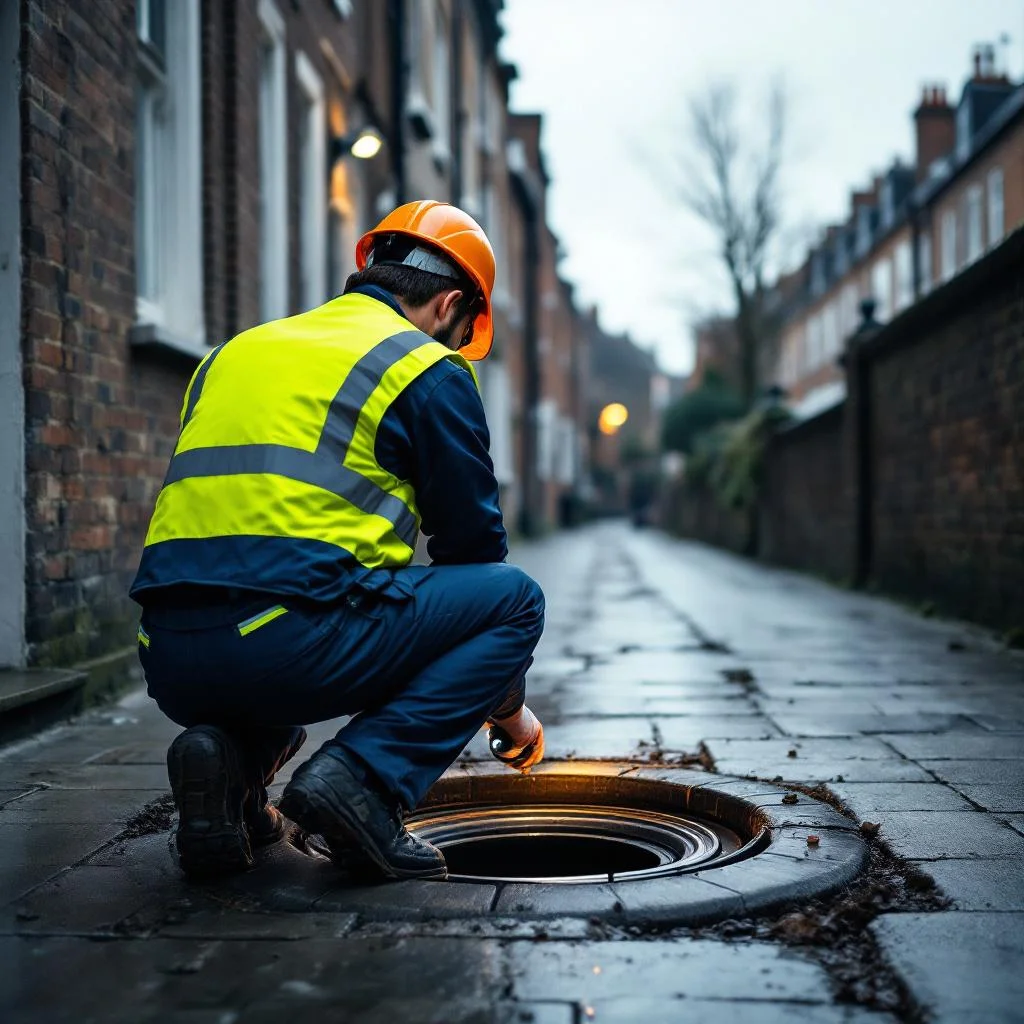
Without a CCTV camera on the first visit, the engineer is guessing about cause. Without a jetter, anything more stubborn than light debris means a return visit and a second invoice. Without proper PPE, the engineer cannot safely lift a chamber lid in inner Southwark or Lambeth, where deeper Victorian chambers are common.
The reason this matters: a single visit with full diagnostic and clearance equipment costs less than three visits with rods alone. Cowboy operators love the rod-only model because every visit is billable and every problem is "more complicated than expected".
5. "Are You Insured for Public Liability and Property Damage?"
Drain work involves machines that can break tiles, fittings, fixtures and sometimes pipes. In a London terraced house with shared walls, the consequences of an unsupervised jetter at full pressure can include flooded neighbours, blown gaskets and damaged plaster. Meaningful public liability cover is the industry standard for drainage contractors in the capital — ask for the specific figure and check it against the insurer's documentation.
Ask the engineer or office to confirm the insurer's name, policy number and cover limit. A genuine firm produces this in seconds. A firm that "will email it later" and never does is one to avoid. If a serious accident happens during the work, the insurance is the only thing standing between you and a contested claim against a sole trader.
There is a related point: insurance only covers competent work performed within the policy terms. An engineer using a domestic jetter on a commercial-scale blockage, or using rods in a way that fractures an old clay pipe, may invalidate cover. Ask whether the firm holds water industry recognised qualifications — for example, a relevant Water Jetting Association ticket for high-pressure work.
6. "Do You Provide a Written Report and Footage After the Visit?"
A written report and any CCTV footage from the visit are the homeowner's evidence base for everything afterwards: insurance claims, Thames Water claims, neighbour disputes, and future buyer disclosures. A firm that does not provide them is asking you to take the diagnosis on trust without any way to verify it later.
This matters especially in shared-drain situations. Since the October 2011 private sewer transfer, drains serving more than one property are Thames Water's responsibility. If your engineer establishes that the blockage is in the shared section, the footage is what gets Thames Water to either reimburse the work or take it on themselves. Without footage, that conversation does not happen.
A reasonable expectation is: a one-page written summary by email within 24 hours, the CCTV recording on a USB or download link if a survey was carried out, and a clear statement of what was found, what was done, and what (if anything) is recommended next. Anything less means the work is essentially undocumented.
7. "What Guarantee Do You Offer on Unblocking and Repairs?"
The standard expectation in London for a routine drain unblocking is a 28-day guarantee — if the same blockage returns within that window, the firm comes back without further charge. Anything shorter than 14 days is unusually weak. Anything that says "no guarantee" is a clear signal to look elsewhere.
For repair work — patch lining, full relining, replacement sections — guarantees are longer. A reputable drain repair or relining job should carry at least a 10-year guarantee on the structural work, in line with the rated life of modern resin liners. Shorter guarantees suggest either weaker materials or a firm that does not expect to be around to honour them.
Ask for the guarantee in writing on the invoice. A verbal "of course we guarantee our work" with nothing on paper is worth what it sounds like. The London drain market is full of trading-name changes and short-lived limited companies; a written guarantee from a firm with a long trading history is meaningfully more valuable than the same wording from a four-month-old company.
8. "Have You Worked on Properties Like Mine in This Borough Before?"
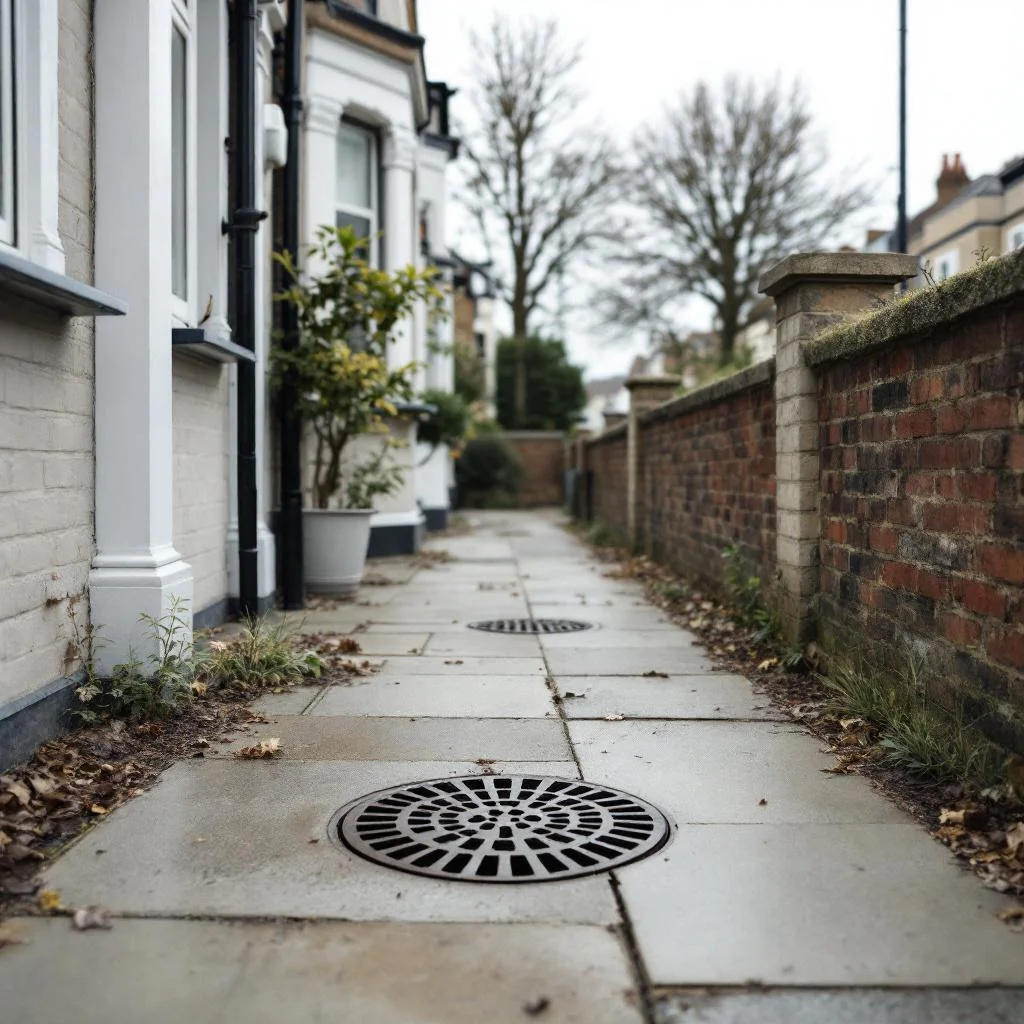
London drainage varies more by borough than most people realise. A firm that has worked extensively in Hackney and Islington understands the typical Victorian terraced layout, the shared-lateral drain runs under back gardens, and the prevalence of root intrusion from mature street trees. A firm that has worked in Bromley understands deeper interwar pipe runs and the surface-water arrangements common in 1930s semis. A firm that has worked in Westminster understands the deeper Victorian commercial chambers and the access constraints of central London streets.
This is not snobbery — it is practical preparation. The engineer who has lifted a hundred chambers in your kind of property knows where to look first, knows which failure modes to expect, and brings the right equipment without a return trip. Our explainer on why London drains block so often describes how borough-specific patterns shape what engineers actually find on the ground.
A useful supplementary question: "What's the most common drainage problem in this part of London?" A good engineer answers without hesitation — root intrusion, fat build-up, joint displacement from clay movement, undersized lateral runs. A vague answer is a sign the firm does not actually do much work in your area.
London-Specific Considerations When Hiring a London Drain Engineer
Beyond the eight core questions, three things matter more in London than almost anywhere else in the UK. First, the boundary between private and public responsibility — the Thames Water responsibility split is more complex in London than elsewhere because of the density of shared drains and the legacy of Bazalgette's combined sewer system. A drain engineer who does not understand this boundary will either bill you for work Thames Water should pay for, or fail to identify when Thames Water can be brought in.
Second, parking and access. Inner London boroughs have controlled parking zones, low-emission zone (ULEZ) charges and red routes. A reputable London firm has accounts and protocols for these and will not pass last-minute parking surprises onto your bill. Ask: "Are parking and any congestion or ULEZ charges included in the quote?"
Third, the housing stock. Pre-1900 properties — common across Camden, Kensington and Westminster — often have non-standard pipe materials, sealed-off historical drain runs and poorly mapped chambers. An engineer used to modern PVC suburban systems will struggle. Ask whether the firm regularly works on Victorian properties; if not, the right specialist will do the job in half the time at a lower total cost.
The pre-hire conversation should take less than ten minutes and gives you almost everything you need to make a confident decision. If a firm cannot answer these questions clearly, the work itself is unlikely to go any better.
Frequently Asked Questions
How much should a London drain unblocking cost in 2026?
The cost of standard residential drain unblocking in London depends on severity, time of day and equipment required. Out-of-hours emergency work carries a premium over standard rates. A fixed price quoted before work starts, with no surprise extras, is the standard you should expect. Our published drain unblocking cost guide explains what drives the price.
Should I get more than one quote for a London drain repair?
For a straightforward unblocking job, a single quote from a reputable firm is usually sufficient and the time spent getting comparison quotes is rarely repaid. For repair, relining or excavation work, two or three quotes are sensible — the price spread across London contractors for the same job can be substantial, and a CCTV survey shared between quotes ensures everyone is pricing the same scope.
What's the difference between a drainage engineer and a plumber?
A plumber works on water supply and waste pipework inside the property — the bath taps, the toilet cistern, the kitchen sink trap. A drainage engineer works on the drain runs from the soil stack outward, including underground pipework, manholes and connections to the public sewer. Hiring a plumber for a blocked underground drain is asking for the wrong tools and the wrong experience.
Can I check whether a London drain firm is legitimate before booking?
Yes. Companies House gives you trading history, registered address and director names. Trustpilot and Google reviews together usually give a balanced picture. Membership of the Water Jetting Association or the National Association of Drainage Contractors signals industry recognition. A firm that is none of these things and has no online history is not necessarily a cowboy, but is harder to verify.
What should I do if a drain engineer tries to upsell on the doorstep?
Refuse to authorise additional work without a written quote and time to consider it. Genuine repairs needed beyond the original unblocking can be quoted, photographed and reviewed without pressure. If the engineer insists work must be done immediately, ask for that in writing along with the technical reason. Pressure-selling on the doorstep is the single most common complaint about cowboy drainage operators in London.