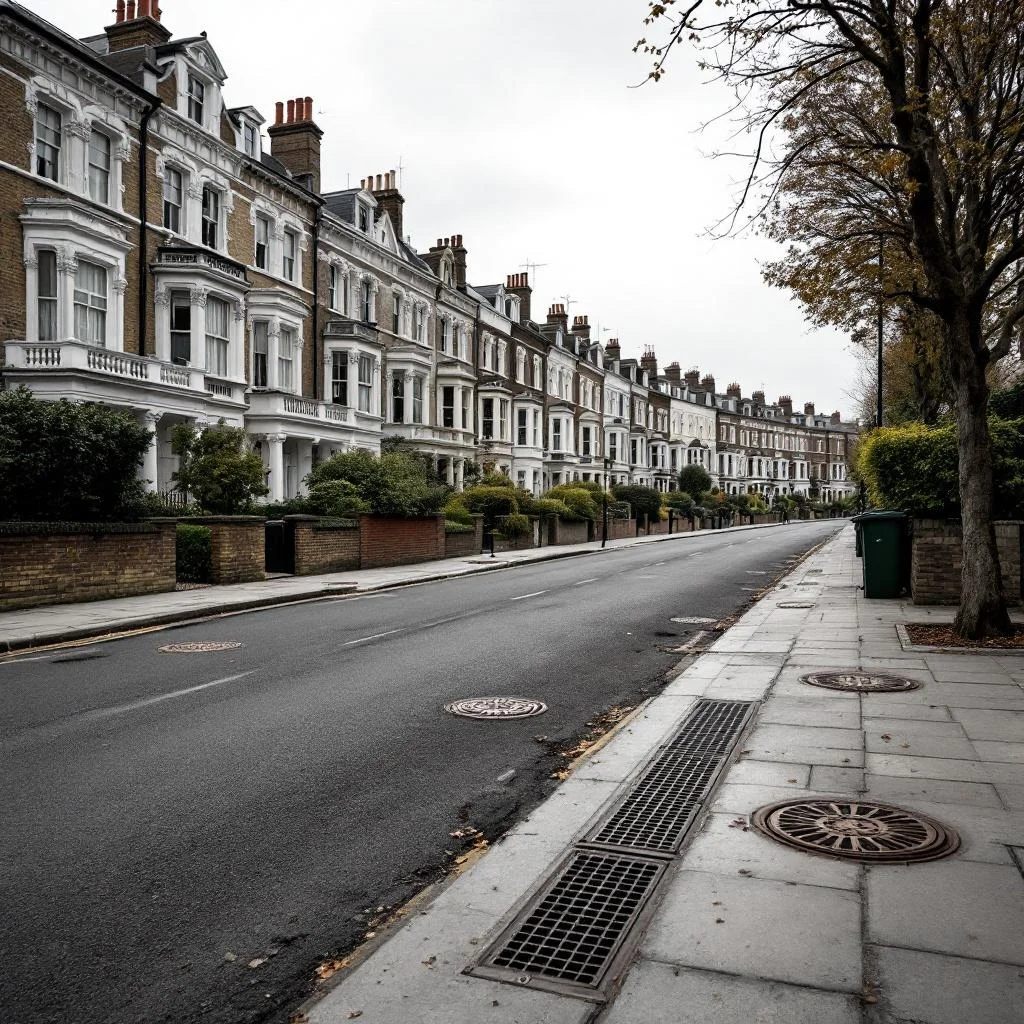
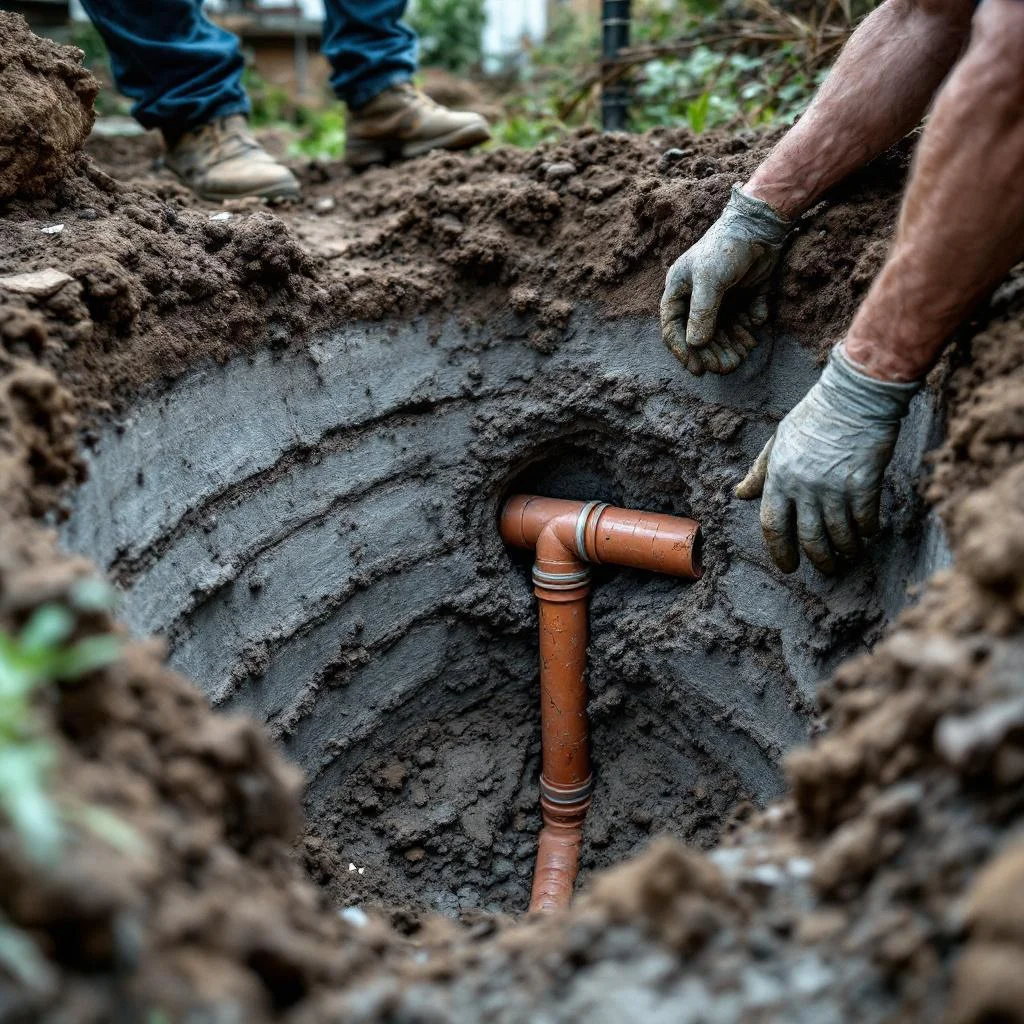
London Clay lies under much of inner north and west London. That includes Islington, Hackney, Haringey, Camden, Barnet, Enfield, Ealing and Brent. Homes on this clay see a pattern of drain failures that is rare in most UK cities. The clay is dense and almost waterproof, and it swells and shrinks with the seasons.
Five failure types account for most clay-area emergencies. They are displaced joints, roots in the joints, failed soakaways, broken pipe sections and sewer surcharging in autumn. Each has a clear signature, and each costs far less to fix early. Knowing which one affects your home leads to a lasting fix instead of a repeat rodding bill.
1. Pipe Joint Displacement from Differential Settlement
This is the most common failure, and the simplest. The clay shrinks in a dry summer and swells back in autumn. The soil under one pipe section moves at a slightly different rate from the soil under the next.
Pipes are rigid, whether clay or modern plastic, so each joint has to absorb the difference. As a result, over time, one pipe lifts out of the next and opens a gap.
A small gap is enough to let in groundwater, silt and root tips. A larger one catches solids on the edge and causes a partial blockage. A bigger one still stops the pipe from connecting properly, so flow leaks out and roots grow in.
Pipes laid in recent decades suffer just as much as Victorian ones. The material matters little, because the joint is the weak point. CCTV surveys in clay areas often find displaced joints spread along a run.
That is the sign of seasonal soil movement, not a fitting fault or a single knock. If the same part of your run blocks every year or so, displaced joints are the likely cause. A CCTV survey will confirm it.
2. Root Intrusion Through Opened Joints
The second failure follows from the first. Once a joint opens, the warm, damp inside of the pipe is hard for roots to resist. London plane is the dominant street tree in inner London.
Silver birch, willow and poplar also seek water aggressively. Furthermore, their roots can travel many metres through clay to reach a leaking pipe.
A single root tip grows into the pipe and branches into a mass of fine roots. That mass catches every passing solid, such as wipes, food debris, paper and hair. The blockage is therefore recurring by nature.
Rodding clears the debris but leaves the roots, and the roots start catching debris again. As a result, within weeks or months, the blockage is back.
Spotting it early matters, because the cost gap is huge. A small intrusion can be cut out with high-pressure water jetting and a root-cutting nozzle. Relining the joint then seals it, at modest cost. A mature root mass can crack the pipe as it thickens.
That means a dig and replacement at a far higher cost. Treat recurrence as the signal. Any blockage that returns within months should prompt a CCTV survey for roots. Our guide on how London Clay damages drains goes deeper.
3. Soakaway Failure
Many London homes send roof rainwater into a soakaway. This is a buried pit, often filled with rubble, that lets rain seep into the soil. It is common in Victorian and Edwardian houses and in 1930s semis in the outer boroughs.
The idea works in sandy or gravelly ground. However, in London Clay it works poorly at best, and it can fail completely.
The reason is simple. London Clay, mapped by the British Geological Survey, is almost waterproof when wet. It acts like a lid, not a sponge.
A soakaway that suits free-draining soil copes with far less water in saturated clay. As a result, in a heavy storm, it fills, overflows and backs up the downpipe.
The symptoms are easy to spot. Water pools round the base of downpipes during heavy rain. Similarly, damp patches appear on inside walls below the downpipe runs. In severe cases, water enters the basement or the space under the ground floor.
You can upgrade the soakaway with crated infiltration units, but that is costly and disruptive in clay. More often, owners redirect the surface water into the foul or combined sewer, with Thames Water consent. DIY is not an option here, because the work needs a survey and the right consent.
4. Broken Pipe Sections from Differential Settlement
Sometimes soil movement is severe enough that the pipe does more than open at the joints. This happens where mature trees stand close to the drain. Their roots pull water from the soil and create sharp local changes in moisture.
A length of clay pipe that sits across two soil zones moving at different rates will crack in the middle. It may then break completely.
On CCTV, a broken section shows up as a clean crack across the pipe. It may show a missing chunk of wall where the piece fell away. It may show a pipe that has flattened or gone oval.
Each of these is a structural failure that cannot seal itself. Rodding and jetting will not cure it. Water leaks out, and groundwater can enter and overload the downstream sewer.
The fix depends on how bad it is. A clean crack with the pipe still in line can often be sealed by relining. A missing section or heavy deformation needs a local drain excavation and a new length. Afterwards, the rest of the run can usually be relined to prevent more failures.
Digging in London Clay is also harder than in most soils. The dense clay needs shoring at depth and takes longer to dig. Budget for this, because a single dig in inner London is a significant cost.
5. Sewer Surcharging During Clay Rebound
The fifth failure is the least obvious. After a long dry summer, the clay has shrunk and the drains are at their most distorted. Joints are at maximum displacement. Then the autumn rains arrive.
The clay takes up water and swells back, sometimes quickly. As a result, the sudden pressure on the drain network can make it surcharge. The foul sewer cannot discharge fast enough, so waste backs up into ground-floor toilets, sinks and bath drains.
Surcharging is worst in low-lying parts of clay boroughs. It also hits homes at the bottom of a hill, where waste from a wider area collects. Symptoms include toilets that will not flush properly in heavy rain and gurgling from several appliances.
In the worst cases, foul water emerges from ground-floor gullies or shower drains. It is a network event, not a single-property one, so one week of rain often produces a cluster of call-outs on a whole street.
There is a partial defence. Specifically, an internal non-return valve at the property's connection stops backflow from the drain into the home. It costs far less than a flood clean-up, and it suits homes that have flooded before.
When surcharging happens, our emergency drain service covers urgent call-outs. Request a quote online via our contact form.
Managing Drain Problems in London Clay Areas
Not all of London sits on clay equally. The worst belt runs through inner north London, including Islington, Hackney, Haringey and parts of Camden. It continues through west London into Ealing, Brent and the edge of Barnet.
South London is more mixed. Parts of Lambeth and Southwark sit on clay, while other areas sit on gravel or sand. Outer south-east London is on chalk in places, which behaves very differently.
Within the clay belt, the worst clusters are often in Conservation Areas with large street trees. The trees draw moisture, and that drives the shrink-swell that damages drains. However, planning rules often prevent tree removal, even where a tree is clearly harming a drain.
As a result, the strategy has to focus on the drain side. Pipe relining, root barriers when replacing pipes and regular CCTV checks are the realistic options.
In practice, owners in clay areas should plan regular CCTV checks, more often near mature trees. They should add a monthly enzyme treatment and act fast on any blockage that recurs within months. Over a decade, this costs less than a single emergency dig. Our drain unblocking pricing and jetting cost guide cover the typical spend for individual works.
Frequently Asked Questions
How can I tell if my drain problems are caused by London Clay rather than something else?
The clearest signal is recurrence in the same part of the run, especially with a seasonal link. Blockages may appear in late summer, when shrinkage opens joints. They may also appear in autumn, when rebound causes surcharging.
A CCTV survey will separate clay-related faults from a one-off cause. If your drain has stayed clear for a few years, clay is unlikely to be the issue.
Does pipe relining work permanently in London Clay areas?
A well-fitted liner forms a continuous pipe inside the old one with no joints. That is the best defence against displaced joints and roots. Manufacturers quote a long design life, but competent fitting is the key.
Poor curing or weak ground preparation can leave defects. We cover relining under our pipe relining service.
Are some boroughs safer than others for buying a London property?
In drainage terms, homes on chalk tend to see less seasonal soil movement than homes on London Clay. Chalk occurs in parts of outer south-east London, including pockets of Bromley and Greenwich. However, the home's own drain history matters far more than the broad geology.
So do nearby mature trees and the age and material of the pipes. A pre-purchase CCTV survey on any pre-1960s home is the most reliable check.
Will my home insurance cover London Clay drain damage?
Standard buildings insurance usually covers sudden, accidental damage to drains. It typically excludes wear and tear, which is how insurers often describe slow joint movement. Subsidence-related drain damage is often covered if subsidence itself is a covered peril.
Read your policy carefully and ask your insurer in writing if in doubt. However, a written CCTV report can support a claim, and it also records existing damage when you sell.
How quickly should I act if I see one of these warning signs?
Act within a month for surcharging, slow drains that worsen, or recurring blockages. A one-off blockage that clears and stays clear is not urgent. The cost rises steeply, because a small displaced joint can become a root mass and then a broken section. Our drain unblocking team can arrange a quick CCTV inspection.
Because every property is different, start with our guides to drain repairs & relining and commercial drain jetting advice. We also cover drain repairs & relining in Westminster and drain repairs & relining in Barnet, so you can see how the work runs near you.
Guides worth reading next
- How London Clay Soil Damages Your Drains (And What To Do About It)
- The 5 Worst London Boroughs for Drain Problems (And Why)
- Tree Root Damage in London Drains: What a CCTV Survey Shows in Sidcup and Chislehurst
- 5 Benefits of a CCTV Drain Survey Before Buying in London
- Clay Soakaway Failures: Barnet, Enfield & Haringey